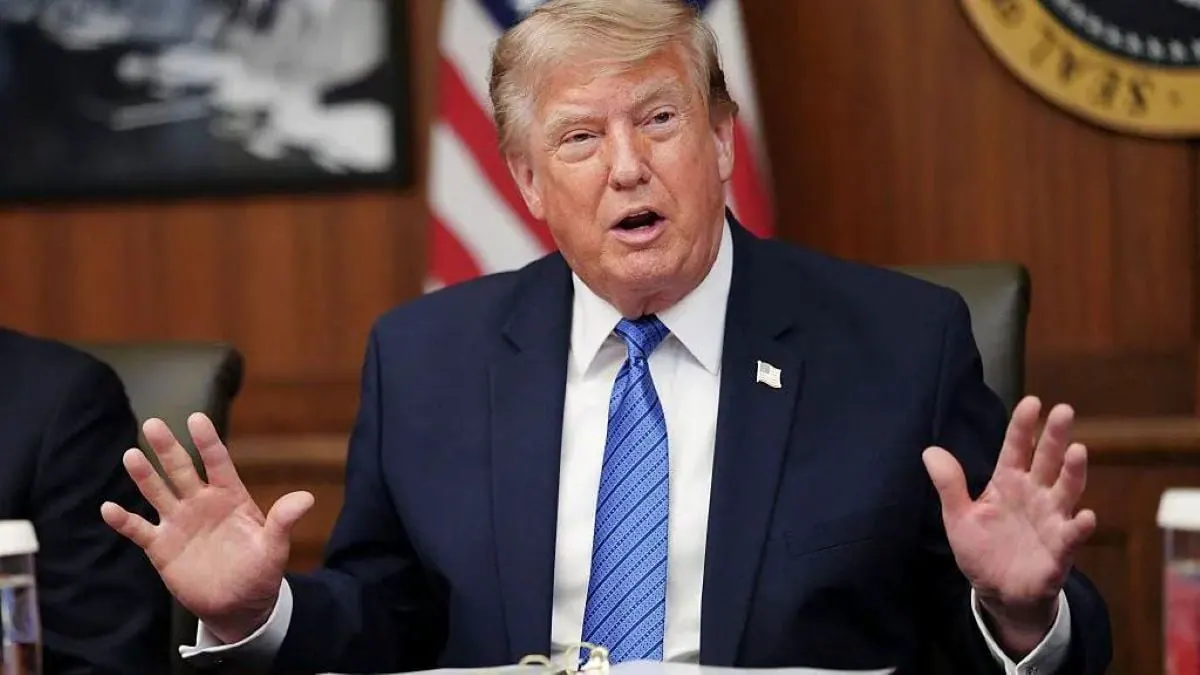
US President Donald Trump addressed the 81st United Nations General Assembly in New York, defending the US-Israeli military campaign against Iran and calling on countries to support economic pressure on Tehran. He emphasized that Iran would never be allowed to obtain a nuclear weapon. Trump stated that his administration had attempted to negotiate with Iran after he returned to office, offering economic cooperation in exchange for an end to its nuclear programme and support for what he described as terrorism.
According to a transcript of the speech, Trump said the central issue was that Iran could not be allowed to obtain a nuclear weapon. “The only thing that does is that Iran will never have a nuclear weapon,” he said. He called on other countries to join the United States in imposing “complete economic isolation” on Iran until Tehran stops attacks on commercial shipping, gives up its nuclear ambitions and ends its support for militant groups.
Trump warned that if no agreement was reached, he could take further military action against Iran. “I have a big decision to make. Will a deal be made with Iran that lets them rebuild and create a far greater country than it ever was before?” he said. “Or do I annihilate the Islamic Republic and do it quickly, never giving them a chance to kill and destroy people and countries again?” This statement had an immediate impact on expectations in the oil market.
Oil prices pared earlier losses after Trump’s speech, as his comments reduced hopes that a US-Iran agreement could be reached during the UN General Assembly. Brent crude futures for November delivery settled at $99.25 a barrel, down $1.09, or 1.09 per cent, while US crude prices also moved lower. Earlier in the session, Brent had traded around $99.94 a barrel, while West Texas Intermediate stood at about $95.43.
The oil market has also been influenced by changing supply conditions in the Gulf. Saudi Arabia restarted its East-West pipeline after it was disrupted by drone attacks, while crude flows through the Strait of Hormuz have increased in recent days. On Wednesday, oil prices remained near their lowest level in more than two weeks as improving Gulf supplies and hopes for further US-Iran diplomatic contacts weighed on the market.
Brent was around $99.41 a barrel in early trading, while WTI was around $90.02. Trump later said US and Iranian representatives had continued talking and that he believed a settlement would eventually be reached. “They want to talk to us. They have been talking to us, even today they’ve been talking to us, and the relationship is developing,” Trump said. “But we can’t let them – and they understand that – we can’t let them have a nuclear weapon.”
The comments leave markets balancing two competing possibilities: continued military confrontation that could threaten regional oil supplies, and diplomatic progress that could eventually restore disrupted flows and ease pressure on crude prices. Trump’s comments affected market expectations because traders had been anticipating the possibility of diplomatic progress during the UN meetings.
Key points
- Trump vowed that Iran would never be allowed to obtain a nuclear weapon during his UN General Assembly speech.
- Oil prices reacted to Trump’s speech, with Brent crude futures settling at $99.25 a barrel.
- Trump said US and Iranian representatives had continued talking and that he believed a settlement would eventually be reached.