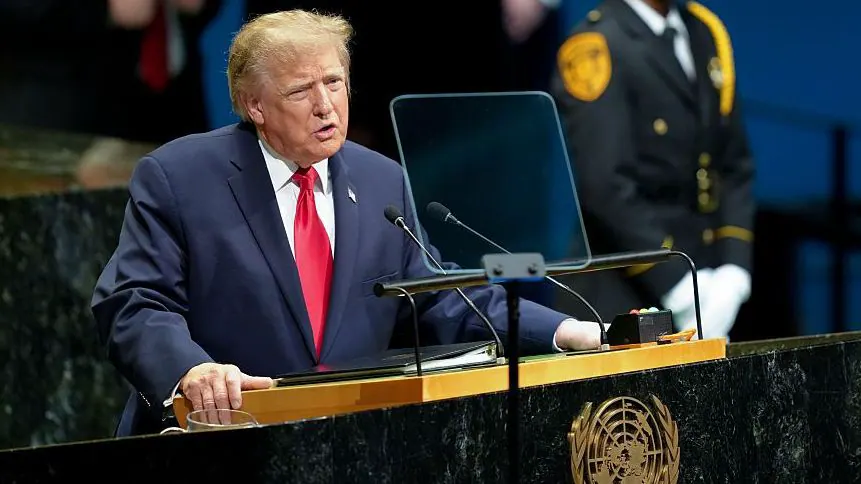
US President Donald Trump addressed the United Nations General Assembly on Tuesday, stating he faces a significant decision regarding Iran, suggesting he could either pursue a peace deal or strike the country again. In his speech, Trump emphasized his stance on Iran, mentioning the possibility of annihilating the Islamic Republic if the conflict remains unresolved. This comes amid rising tensions and a recent military action launched by the US and Israel in February, which has led to increased global oil prices and negatively impacted Trump's approval ratings.
Trump's speech at the UNGA was marked by his assertion of "peace through strength," emphasizing the importance of ultimatums over diplomacy or compromise. He questioned whether a deal could be reached with Iran that would allow the country to rebuild and grow, or if he should instead opt to annihilate the Islamic Republic swiftly. The US president suggested that an Iran deal might materialize after the upcoming US midterm elections in November. His approach to foreign policy, characterized by coercive diplomacy, involves threatening force while keeping negotiations open.
Prior to Trump's speech, UN Secretary General António Guterres had warned about deepening global divisions and highlighted the interdependence of the world's peoples. In contrast, Trump's address focused on justifying the conflict with Iran, which he claimed had prevented Tehran from obtaining a nuclear weapon. He began his speech by highlighting his domestic accomplishments, including the economy, immigration, border security, and tackling violent crime, remarks that seemed more geared towards voters ahead of the midterm elections than towards the diplomats present.
On the sidelines of the UNGA, high-level diplomacy was underway, including a meeting between US and Iranian representatives. Iran's state TV confirmed that Foreign Minister Abbas Araghchi had met with US Special Envoy to the Middle East Steve Witkoff. The talks, facilitated by a Qatari mediator, involved Iran communicating its conditions for negotiations, including an end to the war on all fronts and cessation of US "acts of aggression."
According to reports, the meeting between US and Iranian officials lasted three hours and was described as "very productive" by Trump. The discussions were mediated, with the Qatari mediator shuttling between the two sides. Iranian foreign ministry spokesman Esmail Baghaei noted that Tehran's conditions for talks had been communicated through the mediator.
The talks between the US and Iran took place as Trump engaged with over a dozen world leaders, navigating complex issues such as conflicts in the Middle East and Ukraine that test his foreign policy agenda. Trump's engagement with various leaders contrasts with his criticism of "global government" and his pledge to ensure the US leads in the artificial intelligence race.
The outcome of the US-Iran talks was seen as constructive, with both sides expressing hope for promising results. US Special Envoy Steve Witkoff confirmed that the mediators would continue their work following the initial round of discussions. The developments on the sidelines of the UNGA reflect ongoing diplomatic efforts even as tensions between the US and Iran remain high.
Key points
- US President Donald Trump threatens Iran with potential "annihilation" in a UN speech.
- US and Iranian officials hold productive talks on the sidelines of the UN General Assembly.
- Trump's foreign policy approach combines threats of force with open negotiations, known as coercive diplomacy.