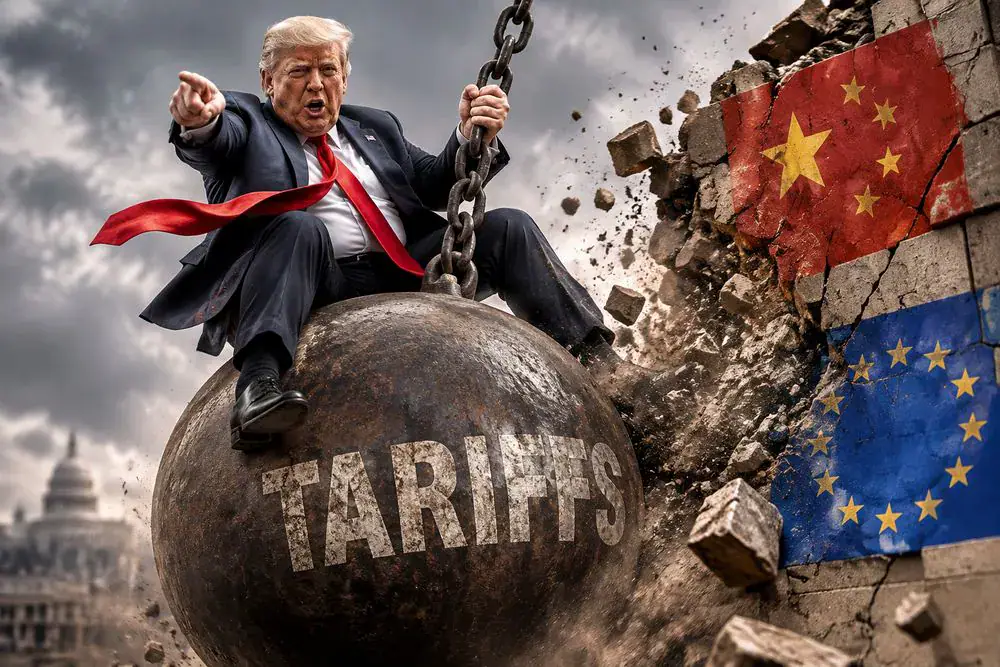
US President Donald Trump has imposed a new round of tariffs on more than a dozen economies, including the European Union, China, Singapore, Switzerland, Taiwan, India, Indonesia, Bangladesh, Cambodia, Malaysia, Thailand, South Korea, and Vietnam. The tariffs, imposed under Section 301 of a 1974 US trade law, target countries the Trump administration believes are unfairly aiding their businesses to compete with US counterparts.
The targeted countries are accused of promoting production and capacity divorced from market principles, including through subsidies and other industrial policies. The Trump administration's move has sparked concerns about the impact on global trade relationships, with even traditional US allies caught in the fallout. The tariffs have significant implications for the global economy, with many countries potentially facing higher costs and reduced trade volumes.
The European Union, traditionally a close ally of the US, has not escaped Trump's wrath. The EU has long enjoyed favourable trade terms with the US, reflecting their close proximity and NATO alliance. However, Trump's unpredictability has left Europe in a tailspin, as the rest of the world struggles to adapt to the new trade landscape. The EU's close relationship with the US has been based on a long history of cooperation, but Trump's tariffs have raised questions about the future of this relationship.
Trump's tariffs are part of a broader shift in global power relations. The US has long been a dominant player in international trade, but Trump's policies have accelerated a shift towards a more multipolar world. The recent APEC summit, SCO, and BRICS meetings have highlighted the emergence of new global power blocs, with countries in Asia and other regions increasingly looking to each other for trade and cooperation.
The impact of Trump's tariffs is being felt far beyond the US and its traditional allies. Many countries are now re-evaluating their trade relationships and seeking new partnerships. The Russian economy, for example, has grown despite Western sanctions since 2022, thanks in part to continued purchases of Russian oil and gas by EU member-states. This has significant implications for global trade and geopolitics.
Trump's economic policies have also had significant implications for South Africa and other countries in Africa. As the global economy continues to evolve, countries are seeking new opportunities for trade and cooperation. The emergence of new global power blocs, such as the SCO and BRICS, has created new possibilities for countries in Africa and other regions to engage with each other and with major economies.
The future of global trade relationships remains uncertain, as countries navigate the implications of Trump's tariffs and the shifting global landscape. One thing is clear, however: the world is rapidly turning away from disintegrating Western hegemony and toward the East. New power relations are being formulated, and old foes are becoming new allies.
Key points
- Trump's tariffs target 16 economies, including traditional US allies, and threaten to demolish established global trade relationships.
- The tariffs have significant implications for global trade and geopolitics, accelerating a shift towards a more multipolar world.
- The emergence of new global power blocs, such as the SCO and BRICS, has created new possibilities for countries to engage with each other and with major economies.
Reporting sources
- Trump’s tariffs set to accelerate global power shift · Pretoria News