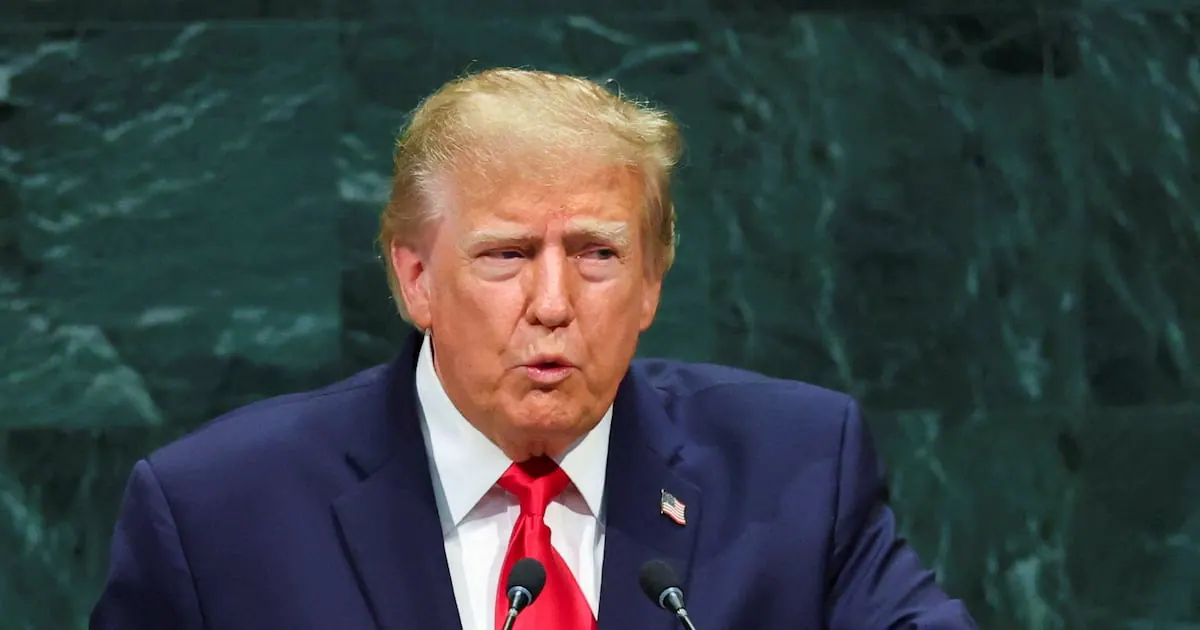
US President Donald Trump's recent actions towards South Africa have sparked controversy, with analysts viewing his stance as typical brinkmanship. Despite Congress approving the extension of the African Growth and Opportunity Act (Agoa) to 2028, allowing South Africa relatively easy entry to the US market, Trump signed it off with indications that the White House was not keen on retaining South Africa as one of the beneficiaries. This move has raised questions about Trump's intentions and motivations.
Trump's administration has announced its intention to impose travel restrictions on South African officials responsible for the country's racial redress policies, which Trump views as "reverse racism." This move has been seen as a shakedown, with Trump known for using strong-arm tactics to achieve his goals. The US is engaged in an unnecessary war against Iran, driven by Trump's desire for historical significance, and his actions towards South Africa may be part of a larger pattern of self-glorification.
Trump's demands on the South African government reflect a historical, ideological bond with the Afrikaner right wing, driven by a shared settler colonial past and ideology of racist supremacy. Both the US and South Africa were founded on violence and justified discrimination through bigotry, with racial supremacy as a state ideology. This shared history has created a bond between Trump and the Afrikaner right wing, which seeks to unravel the constitutional foundations of South Africa's democracy.
Thabo Mbeki, the second president of democratic South Africa, has written a paper titled "The United States of America and Future of Afrikaners in South Africa," which explores the historical and ideological ties between Trump and the Afrikaner right wing. Mbeki argues that Trump's attack on South Africa's racial redress policies is driven by a desire to protect the interests of the Afrikaner right wing, which has been making trips to Washington to enlist Trump's help in reversing racial redress.
The FF Plus, a right-wing party in South Africa, has been at the forefront of efforts to enlist Trump's help in reversing racial redress. This has highlighted the contradictions within the government of national unity, which contains elements that seek to unravel the constitutional foundations of South Africa's democracy. The ANC, which has elevated these elements to positions of national prominence, is now in a quandary, purporting to fight the counter-revolution while allowing its elements to expand.
Mbeki labels the Afrikaner right wing, including those who occupy seats in parliament and government, as counter-revolutionaries. This has significant implications for South Africa's democracy, with black people standing as FF Plus candidates in the coming local elections. The situation has created a complex and challenging environment for the ANC and other parties, which must navigate the contradictions within the government of national unity.
The controversy surrounding Trump's actions towards South Africa has significant implications for the country's future. As Professor Mcebis Ndletyana, a professor of political studies at the University of Johannesburg, notes, Trump's stance reflects a deeper ideological bond with the Afrikaner right wing, driven by a shared history and ideology of racist supremacy. This bond has significant implications for South Africa's democracy and its relationships with the US.
Key points
- Trump's stance on South Africa reflects a historical, ideological bond with the Afrikaner right wing, driven by a shared settler colonial past and ideology of racist supremacy.
- The FF Plus has been making trips to Washington to enlist Trump's help in reversing racial redress, highlighting the contradictions within the government of national unity.
- Trump's actions towards South Africa have significant implications for the country's future, including its democracy and relationships with the US.