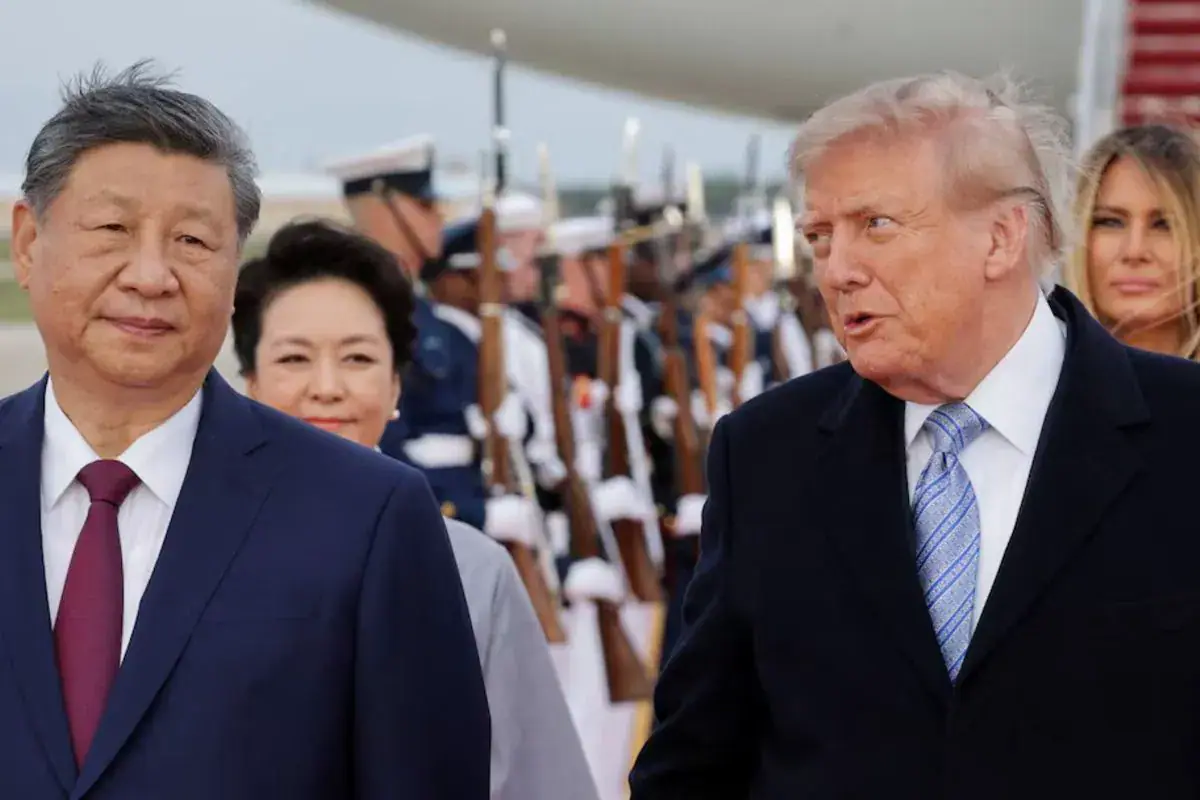
US President Donald Trump is set to visit Asia this week, with a fragile trade-war truce between the US and China extended to early next year. His trip comes after a midterm election drubbing and criticism that his administration failed to act on intelligence that Nvidia CEO Jensen Huang had an affair with a suspected Chinese spy. These developments have raised the stakes for his meeting with Beijing's powerful leader, Xi Jinping.
Trump will first visit Manila for meetings with Southeast Asian and other regional leaders on Tuesday before jetting to Shenzhen for the Asia-Pacific Economic Cooperation (APEC) forum. There, he will meet Xi and hold three-way discussions with Xi and Russia's Vladimir Putin. Some analysts had initially billed the Shenzhen meeting as a low-stakes summit, but the recent backlash against Trump's Republican Party and the Nvidia saga have muddied those expectations.
The Nvidia scandal, including allegations that restricted semiconductors were diverted to Chinese customers, is expected to harden US attitudes towards China. US House Speaker Mike Johnson said last week there was growing consensus in Congress on further limiting Chinese access to advanced chips after the scandal. Democrats are expected to press hard on the issue when they take over the House and Senate majorities in January.
China has said the United States has fabricated the spy narrative to justify a technological blockade. Zhu Feng, director of the Institute of International Studies at Nanjing University, said the spat could also speed up "the decoupling of AI" between the world's two superpowers. Trump is not expected to directly raise the spy allegations with Xi, according to a senior US administration official.
Rather than picking fresh fights with China, Trump may want to focus on legacy-building endeavours such as denuclearisation agreements with Beijing and Moscow. Trump sees the unprecedented summit with Xi and Putin as possibly providing movement towards an agreement on nuclear arms control. However, Chinese analysts say that is a non-starter for China, which has far fewer warheads than the others.
Trump may also seek to enlist Putin and Xi's support in setting up a future meeting with North Korea's secretive leader, Kim Jong Un. The president will be focused on "building his legacy," said Victor Cha at the Center for Strategic and International Studies. A big part of that is his North Korea diplomacy, which he has devoted a lot of time to over his two terms.
Xi could also seek to take advantage of Trump's political weakness after his election humbling, analysts say. Top of Beijing's wish list is ensuring that the US president doesn't approve a $14 billion arms package to Taiwan, which China claims as its own. Both leaders will also be wary of reigniting a trade row that threatened to tank the global economy and financial markets last year.
Key points
- The US and China have agreed to extend their trade-war truce to early next year.
- The Nvidia scandal is expected to harden US attitudes towards China.
- Trump may focus on legacy-building endeavours such as denuclearisation agreements with Beijing and Moscow.