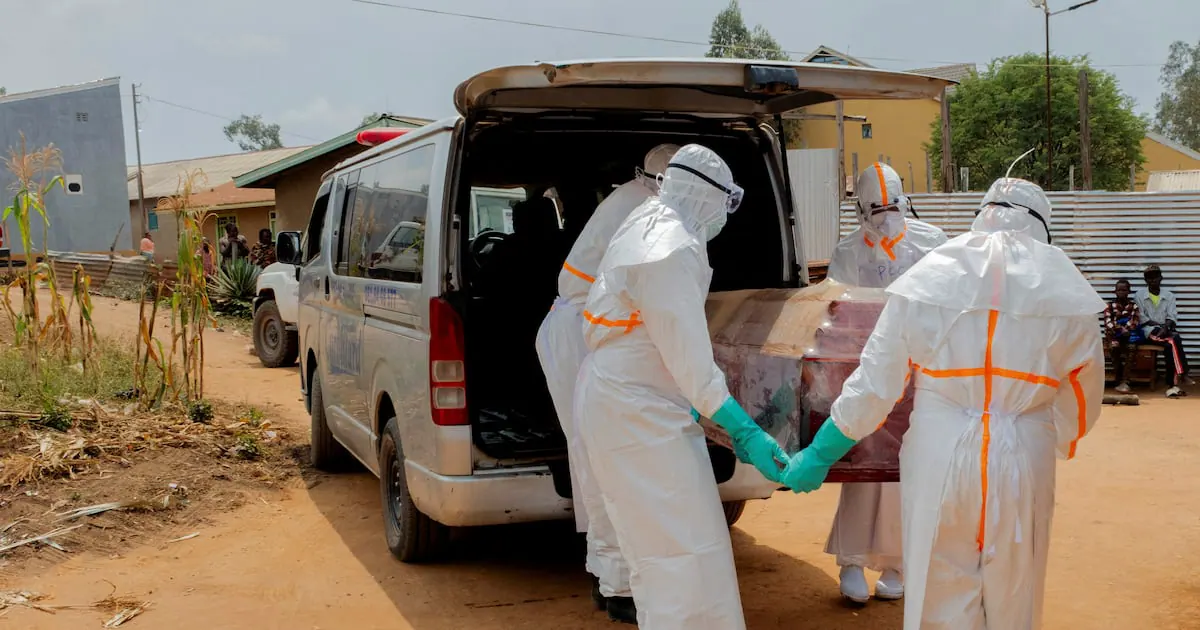
The US government's response to the Ebola outbreak in the Democratic Republic of Congo (DRC) has been hindered by the 'America First' policy, prioritizing border controls over fighting the disease. When US doctor Patrick LaRochelle was exposed to Ebola in a mining town in DRC in May, he expected to be rushed home for treatment, like during a previous outbreak in 2018. However, the White House directed that no US citizens would be brought home for treatment, instead setting up a 50-bed Ebola quarantine camp on an air force base in Kenya.
The decision to deny US citizens treatment at home and impose a 21-day quarantine policy has dramatically slowed the flow of American medical volunteers, increasing the strain on local doctors and weakening the overall response. This policy has resulted in a significant decrease in the number of American medical staff, with US faith-based aid organisation Samaritan's Purse reporting that Americans once made up 80% of staff at their Ebola treatment centres in DRC, now down to about 20%. The cost of deploying medical professionals has more than doubled due to the quarantine policy.
The Trump administration's shutdown of the US Agency for International Development (USAID) and withdrawal from the World Health Organisation (WHO) have left a hole in the supply chain for medicines and equipment, disrupting medical work in a country almost six times the size of California. Medical missionary LaRochelle was transported to an isolation unit in Prague in the Czech Republic, while his infected US colleague Peter Stafford went to Germany for treatment and recovered. Both doctors praised their care but expressed sadness at not being flown home.
The US Department of Health and Human Services has taken a backseat in the Ebola response, with Health Secretary Robert F Kennedy Jr, a longtime anti-vaccine activist, showing little interest in accelerating vaccine development for the Bundibugyo virus, a rare Ebola species. Instead, the US State Department has contributed $50m to the Coalition for Epidemic Preparedness Innovations (CEPI), which has allocated $100m to fund Bundibugyo vaccine research but needs another $128m for a large-scale trial in DRC.
The characterisation of the US Ebola response has been disputed, with Health Department spokesperson Emily Hilliard stating that the department is leading extensive work both at home and in Africa, and that protecting Americans from importation and combating the outbreak at its source are essential parts of the response. However, public health officials say that stopping Ebola from entering the US is a legitimate goal, but the 21-day quarantine policy is having a tangible impact on staffing and morale.
The absence of Health Secretary Kennedy during the second-worst Ebola outbreak on record has left a vacuum filled by Secretary of State Marco Rubio and top White House official Stephen Miller, who pushed the closed-borders strategy aggressively. US doctor Patrick LaRochelle expressed frustration with the decision-making process, stating that it felt like decisions were patched together and reactive, and that he sometimes feels angry about the situation.
The impact of the US government's response to the Ebola outbreak in DRC has been significant, with over 4,000 people killed and the disease spreading at the fastest rate ever. Franklin Graham, CEO of Samaritan's Purse, expressed concern that medical workers are not being treated as heroes, saying that it has been difficult and discouraging for them, and that the most effective way to respond to an Ebola outbreak is to safely bring highly trained medical professionals to the epicentre.
Key points
- The US government's 'America First' policy has hindered the Ebola response in DRC by prioritizing border controls over fighting the disease.
- The 21-day quarantine policy has slowed the flow of American medical volunteers, increasing the strain on local doctors and weakening the overall response.
- The US Department of Health and Human Services has taken a backseat in the Ebola response, with Health Secretary Robert F Kennedy Jr showing little interest in accelerating vaccine development.