US President Donald Trump has stated that the United States will not pursue a joint venture with China to develop artificial intelligence (AI), arguing that it would be equivalent to "giving away secrets" to America's main economic rival. This announcement was made during an event in Washington on Tuesday, where Trump also expressed his opposition to imposing restrictions on AI technology, citing concerns that it would stifle future growth.
The announcement comes after Chinese President Xi Jinping's visit to the White House last week, where both countries launched a new AI dialogue, with further talks scheduled for November. Additionally, the two countries established a new communications channel to prevent misunderstandings during AI-related incidents. Trump emphasized that the US is "leading by a lot" in the AI sector and does not want to "mix it up" with potential competitors.
Trump argued that if the US were to collaborate with China on AI, it would give China immediate access to sensitive information that they currently do not possess. He stated that "we're leading now over China and everyone else, and I want to keep it that way." The US president also mentioned that the topic of AI was discussed during his meeting with President Xi last week, but he remained opposed to any joint cooperation to develop the technology.
Prior to Trump's meeting with Xi, China's foreign ministry warned that "narratives of threat" and confrontation hindered AI governance. In a separate meeting with representatives of government agencies and technology companies, including OpenAI, Anthropic, and Meta, Trump stated that there was a "belief that there should be tremendous self-regulation" in the AI sector.
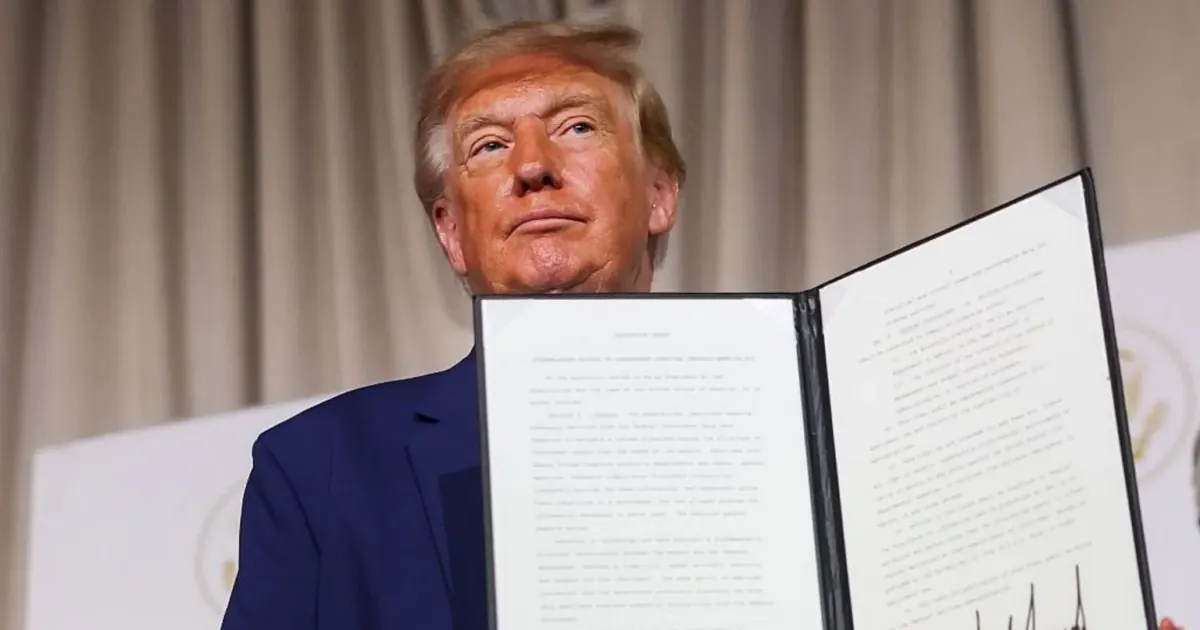
During the meeting, Trump revealed that the technology leaders had signed a "morally binding" document that would serve as a "form of protection" from the potential hazards of AI. He also mentioned that a "Super Intelligence Czar" would likely be appointed in the coming days. An executive order expected to be signed on Tuesday afternoon would formally change the name of AI to "Super Intelligence" in government documents.
Domestically, Trump has faced increasing public concern over the potential dangers of AI and calls for additional guardrails to be put in place. A recent poll published by Politico in late September found that two of every three Americans believe there is at least a "moderate" risk that AI could destroy humanity. However, Trump has repeatedly downplayed safety concerns, referring to them as a "hoax" and comparing them to the "global warming scam" he claims is "being perpetrated by radical left Democrats".
The US president's stance on AI has been met with mixed reactions, with some experts warning that a lack of regulation could lead to significant risks, while others argue that over-regulation could stifle innovation. As the US and China continue to engage in discussions on AI, it remains to be seen how the two countries will navigate their differences on this critical issue.
Key points
- Trump opposes joint US-China AI venture due to concerns over intellectual property.
- US and China have launched a new AI dialogue, with further talks scheduled for November.
- Trump plans to appoint a "Super Intelligence Czar" to oversee AI development in the US.