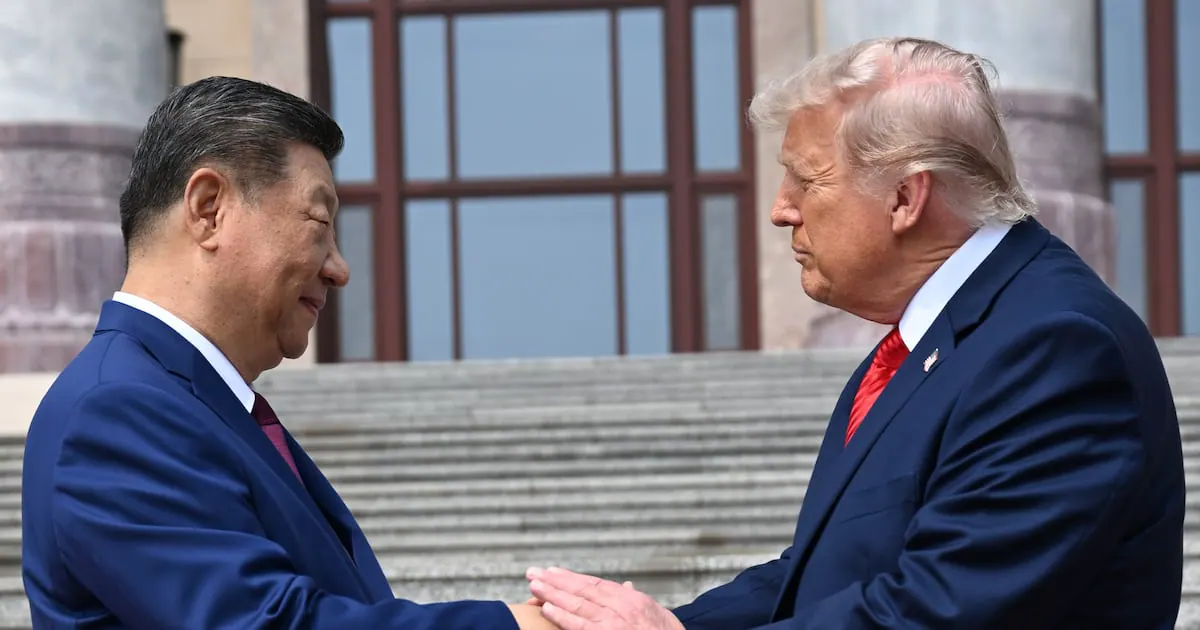
US President Donald Trump has dramatically shifted his approach to China, moving from criticizing the country as a menace to the US economy to now speaking in glowing terms about Chinese President Xi Jinping. During his presidential campaign, Trump accused China of gutting America's factories and eroding the middle class, but since then, he has increasingly praised Xi, describing him as a "great gentleman" with whom he has a "very good relationship." This change in tone comes as China and the US are in a contest for global leadership.
Trump's magnanimity towards China comes as the country has expanded its dominance in manufacturing and pushed into new technologies such as artificial intelligence (AI) and electric vehicles (EVs), creating risks for the economies of several countries, including the US, Germany, Italy, France, South Korea, and Japan. Despite this, Trump has given Xi a pass on several issues, including reports that China provided Iran with satellite imagery. Trump's change in approach has been seen as a result of his initial attempt to use super-high tariffs and export restrictions, which was unsuccessful.
Trump's efforts to confront China with tariffs backfired, and he has since resorted to hospitality, including a state dinner for Xi at the White House. The two leaders could meet again two more times this year at international summits. Trump has readied a helipad on the White House South Lawn before Xi's arrival and has lamented that his ballroom will not be ready to host the Chinese leader. This shift in approach has been seen as a strategic move by Xi, who has used Trump's change in tone to his advantage.
According to Michael Kovrig, a senior adviser at the International Crisis Group, Trump has dramatically shifted his approach to China because his initial attempt to use super-high tariffs and export restrictions was unsuccessful. Kovrig notes that Trump has largely undermined the economic and national security alliances that could previously apply pressure on China. Trump's relationships with traditional US allies have been strained, including with French President Emmanuel Macron and Canada.
Trump's relationship with Xi has led to some symbolic wins, including a pair of reciprocal state visits, which could be seen as a sign that the leaders of the world's two largest economies feel comfortable speaking to each other. The trade imbalance with China in goods has declined relative to the same period in 2025, according to Census Bureau figures. However, China appears to be routing more goods through other nations, such as Vietnam, to minimize the tariffs.
Despite Trump's continued tariffs on China, the country's manufacturing sector has not been curbed. China has found new markets and boxed out competition from other industrialized countries. China is exporting more of its goods to the rest of the world, with a $1.2-trillion global trade surplus last year. Its low-priced EVs have undercut the car sectors in Germany, Japan, and South Korea.
It is unclear whether Thursday's visit will have a policy "deliverable," but it is possible that the main deliverable will be the relationship itself, rather than clear and measurable goals. Evan Medeiros, a professor at Georgetown University, notes that the US might not be positioning itself to compete against China as it should be. The visit comes as China and the US are both using their trade truce to retrench, with China building up its military and AI capabilities despite limited access to advanced computer chips.
Key points
- Trump has shifted his approach to China, moving from criticism to praise for President Xi Jinping.
- The US-China relationship has significant implications for global leadership and trade.
- The outcome of Thursday's visit is uncertain, with no clear policy "deliverable" announced.