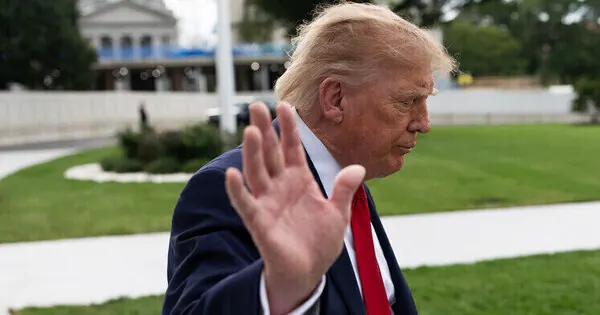
US President Donald Trump has publicly rejected Iran's latest proposal to reopen the Strait of Hormuz and restart nuclear negotiations. In a statement, Trump said that Tehran wants an agreement because it is losing so badly under Washington's blockade. He made the comments on Saturday while speaking to reporters outside the White House.
Iran presented Washington with a "concrete seven-day plan" during the UN General Assembly in New York this week. The plan, as described by Foreign Minister Abbas Araghchi, involves Tehran reopening the Strait of Hormuz and resuming negotiations over its nuclear program if the US lifts its naval blockade, eases restrictions on Iranian oil exports, releases frozen Iranian assets, and observes a ceasefire that includes an end to Israel's combat operations in Lebanon.
Trump stated that he rejects Iran's proposal, saying that Tehran wants to make a deal because they are "losing so badly". He added that he likes making deals, but the terms presented by Iran would not be acceptable. However, he did not specify which conditions he opposed. Araghchi said that Tehran had seen Trump's public rejection but was still waiting for a formal US response.
According to Araghchi, if the necessary conditions are met, the strait can be reopened and normal maritime passage restored within seven days. He added that "the choice now rests with the United States". Trump argued that Iran had "outsmarted themselves" by restricting traffic through the strategic waterway, which led to the US blockade that deprived Tehran of oil revenues.
The US president has repeatedly claimed that Washington maintains full control of Hormuz and holds the stronger negotiating position. At the UN General Assembly on Tuesday, Trump declared that he faced a "big decision" over whether to "annihilate" the Islamic Republic if negotiations failed. His public rejection confirms earlier reporting by the Wall Street Journal that he had turned down the proposal and told aides he expected renewed US bombing of Iran after the November midterm elections.
Despite Trump's public rejection, US officials said that negotiations through regional mediators were continuing. Araghchi also said that Tehran had taken note of Trump's public rejection but was still awaiting a formal US response. The development comes amid heightened tensions between the US and Iran, with both countries engaging in a war of words and actions.
The rejection of Iran's proposal has significant implications for the region, with many countries watching the developments closely. The Strait of Hormuz is a critical waterway for global oil exports, and any disruption to traffic could have far-reaching consequences for the global economy. Key players, including the US and Iran, will likely continue to engage in diplomatic efforts, but the outcome remains uncertain.
Key points
- Trump rejects Iran's proposal to reopen the Strait of Hormuz, calling the terms "unacceptable".
- Iran's proposal involves lifting US sanctions and observing a ceasefire in exchange for reopening the Strait of Hormuz and resuming nuclear negotiations.
- Negotiations between the US and Iran are ongoing, despite Trump's public rejection of Iran's proposal.