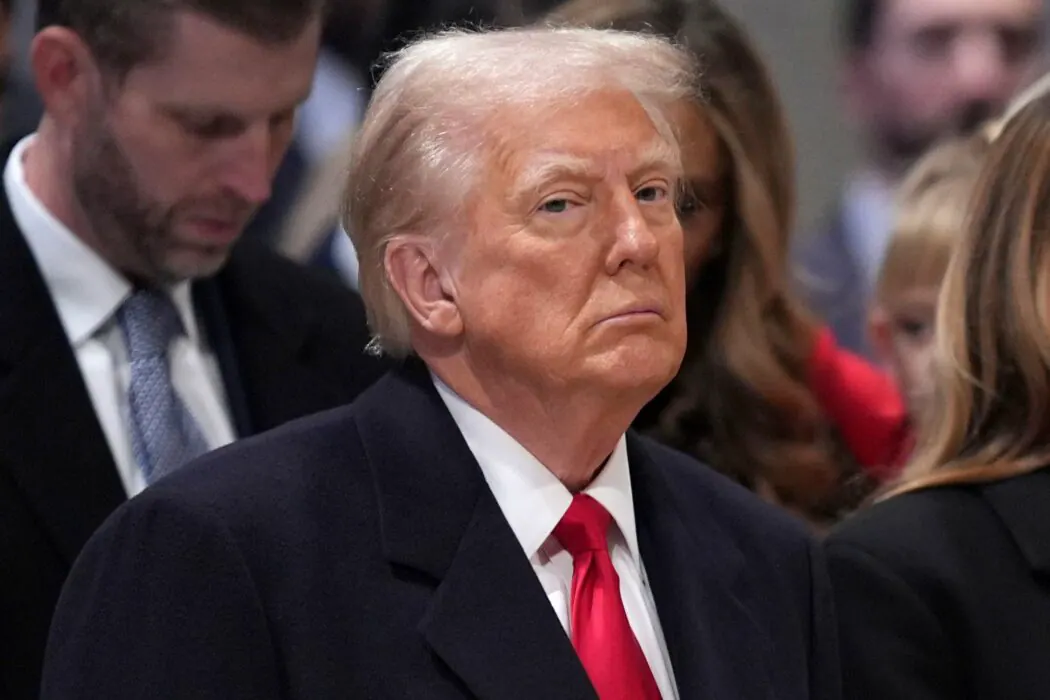
US President Donald Trump has proposed a new term for artificial intelligence, suggesting that it be referred to as "super intelligence" in US government documents. During his address to the United Nations General Assembly in New York on Tuesday, September 22, Trump argued that the term "artificial" diminishes the technology's capabilities. He announced that the US would adopt the new terminology, abbreviating it as "S.I." The move aims to reflect the technology's potential more accurately, according to Trump.
Trump's announcement was part of a broader discussion on AI at the UN General Assembly. He reiterated his opposition to international efforts to impose new controls on AI, describing them as a "globalist scheme." Trump emphasized that the US should continue to develop AI rather than restrict its growth. He framed the development of advanced AI as a strategic competition, particularly with China, suggesting that the country that leads in AI will have a significant advantage.
The term "superintelligence" already has a specific meaning in discussions about advanced AI. It typically refers to a hypothetical form of machine intelligence that surpasses human capabilities across a broad range of tasks. Trump's proposed use of "super intelligence" differs from this concept, and it is unclear how widely the new terminology will be adopted across the US government. The debate over AI safety and regulation continues internationally, with world leaders and UN officials calling for greater cooperation and safeguards.
Trump's comments on AI were met with mixed reactions, reflecting the complexities of the issue. While some countries are pushing for stricter controls on AI, others, like the US, are hesitant to limit its development. Trump argued that the US should maintain its lead in AI while pursuing its economic and strategic potential. This approach has sparked concerns about the potential risks and benefits of advanced AI.
The proposed new terminology has sparked debate among experts and policymakers. Some argue that it reflects a more positive view of AI, while others are concerned that it may not accurately convey the technology's complexities. As AI continues to develop, the discussion around its regulation, safety, and terminology is likely to intensify. The US government's adoption of the new term may influence international discussions on AI.
The international community remains divided on how to approach AI regulation. While some countries are advocating for stricter controls, others believe that over-regulation could hinder innovation. Trump's proposal to rename AI as "super intelligence" has added a new layer to the debate, highlighting the complexities of the issue. As AI continues to evolve, finding a balance between innovation and regulation will be crucial.
The impact of Trump's proposal on US government documents and international discussions remains to be seen. The adoption of the new term "super intelligence" may influence how AI is perceived and addressed globally. Key stakeholders, including governments, experts, and industry leaders, will be watching closely as the debate unfolds.
Key points
- Trump's proposal to rename AI as "super intelligence" aims to reflect the technology's potential more accurately.
- The new term differs from the existing concept of "superintelligence" in AI discussions.
- The proposal has sparked debate on AI regulation, safety, and terminology internationally.