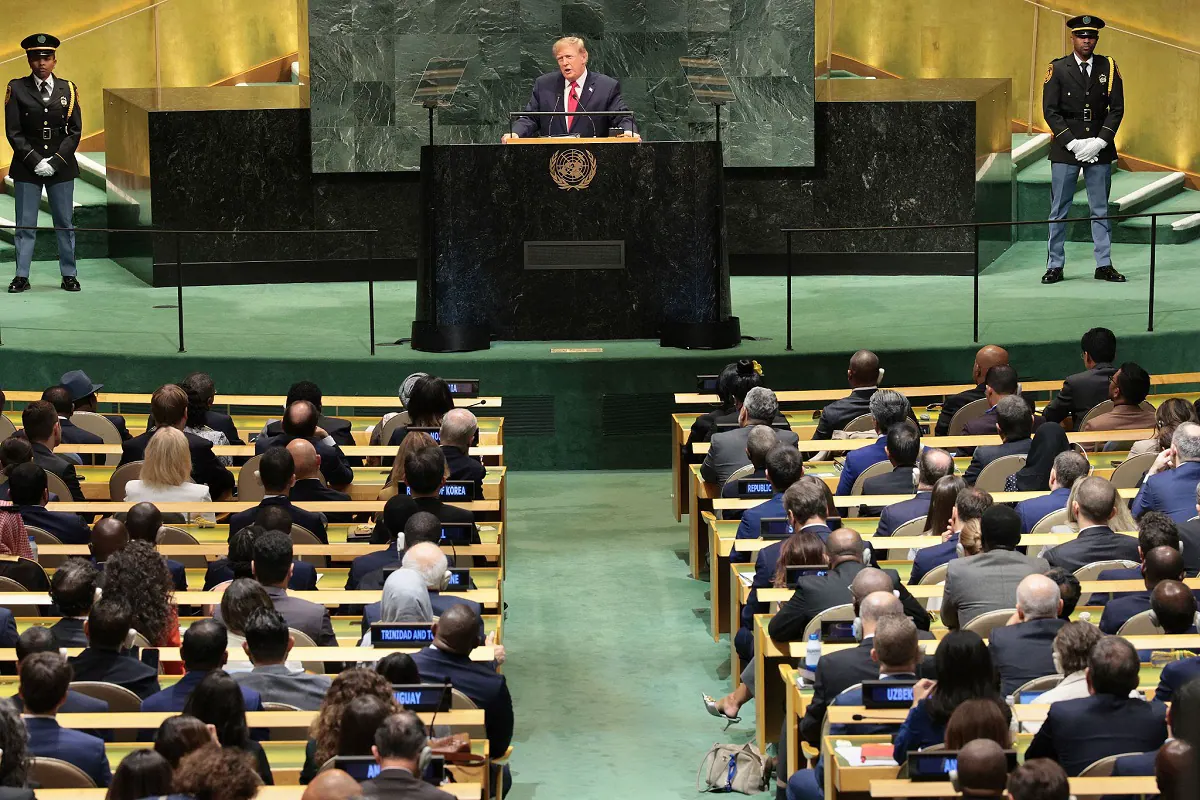
US President Donald Trump has announced plans to replace the term "artificial intelligence" with "super intelligence" in government documents. Speaking at the United Nations General Assembly in New York on September 22, 2026, Trump argued that the term "artificial" made the technology sound fake. He suggested that the new name sounded better and urged other countries to adopt it. This move is part of a broader effort to rebrand AI and position the US as a leader in the field.
Trump's announcement went beyond terminology, as he also rejected international efforts to control AI development. He presented AI development as a contest for national power and made clear that his administration would resist restrictions that could slow American companies. Trump compared warnings about AI's dangers to climate warnings, arguing that fear should not prevent development. He emphasized that he would not stifle growth in the sector, which he believes could have a bigger impact than the industrial revolution.
The US president claimed that the United States is ahead of China and other competitors in AI development, presenting leadership in the technology as a decisive advantage. However, he did not provide a benchmark for measuring this lead. Trump's remarks emphasized the importance of AI development for national power and competitiveness. He also suggested that the impact of AI could exceed that of the internet.
Despite opposing new restrictions, Trump said the Justice Department could act against AI companies if necessary. This leaves an enforcement role for the government alongside his promise to encourage rapid development. The speech announced a change in language and defended his approach to oversight, but it did not establish that AI risks had been resolved. The Justice Department's potential intervention adds a layer of regulatory complexity to the AI sector.
Trump's comments on AI were made at the United Nations General Assembly, where he also addressed other global issues. His speech highlighted the challenges and opportunities presented by technological advancements. The US president's approach to AI development has been shaped by his administration's priorities and goals. Trump's emphasis on AI as a driver of national power reflects the growing importance of technology in international relations.
The proposed rebranding of AI as "super intelligence" has sparked interest and debate. While some see it as a semantic change, others view it as a reflection of the US's ambitions in the sector. The impact of Trump's announcement on the global AI landscape remains to be seen. As the technology continues to evolve, governments and companies are grappling with the implications of AI development and deployment.
The US's approach to AI development is being closely watched by other countries, including China. The global competition for leadership in AI is intensifying, with significant implications for the economy and society. As the technology continues to advance, governments and international organizations will need to address the challenges and opportunities it presents. The debate over AI development and regulation is likely to continue in the coming months and years.
Key points
- Trump proposes replacing "artificial intelligence" with "super intelligence" in US documents.
- Trump rejects international efforts to control AI development, citing concerns about stifling growth.
- The US president claims the US is ahead of China and other competitors in AI development.