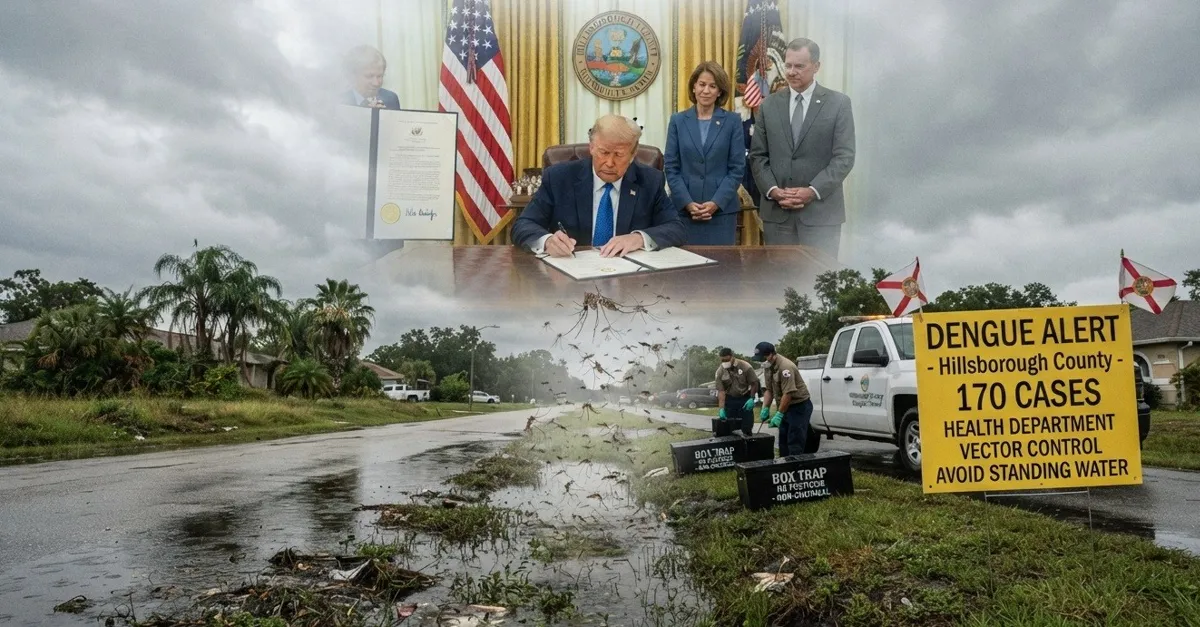
US President Donald Trump has declared war on mosquitoes and ticks, signing an executive order to tackle the issue across the United States. The order, signed on Tuesday, instructs the Interior Secretary, Agriculture Secretary, and other federal officials to develop a comprehensive plan to reduce invasive mosquito populations by 90% and tick populations by 50% within two years. The plan prioritizes commercial solutions and cooperative agreements over traditional chemical pesticides.
The executive order comes as Florida faces an unprecedented outbreak of dengue fever, with 190 locally acquired cases reported in 2026, according to the state's health department. The outbreak has prompted three counties to declare a state of emergency. Heavy rainfall has been cited as a contributing factor to the spread of the disease, which is transmitted by a specific species of mosquito. The Florida Department of Health has reported cases in six counties, with Hillsborough County accounting for 170 of the cases.
The federal plan will not only focus on ground-level control but also involve building a research and technology framework to combat mosquitoes and ticks. Several federal agencies have been directed to develop a regulatory framework that keeps pace with emerging technologies in the field, with a focus on non-chemical methods that are considered safe and effective. The administration aims to accelerate innovation through research competitions, government programs, and public-private partnerships.
The executive order also highlights the need for research into the prevention and treatment of insect-borne diseases. The Centers for Disease Control and Prevention (CDC) and other health agencies have been directed to build on existing efforts to combat Lyme disease and other tick-borne illnesses. Additionally, the order instructs agencies to study options for labeling products that contain high levels of alpha-galactose, a substance linked to a severe meat allergy caused by tick bites.
The alpha-gal syndrome, also known as alpha-gal allergy, is a condition that causes a severe allergic reaction to red meat. The order notes that the allergy is often caused by tick bites and directs federal agencies to explore ways to protect consumers from the risks associated with this condition. The move is seen as an effort to expand the fight against insect-borne diseases beyond just eradicating the insects themselves.
The Trump administration's move has been seen as a response to growing concerns about the spread of insect-borne diseases in the US. The CDC has warned that the risk of local transmission of dengue fever and other mosquito-borne diseases is increasing. The executive order emphasizes the need for a comprehensive approach to addressing the issue, including research, technology, and community engagement.
The situation in Florida highlights the challenges posed by insect-borne diseases, and the need for effective solutions. With the number of dengue fever cases on the rise, local authorities are urging residents and visitors to take precautions to prevent mosquito bites. The Trump administration's executive order is seen as a step towards addressing the issue, but its effectiveness remains to be seen.
Key points
- The Trump administration has launched a comprehensive plan to combat invasive mosquitoes and ticks nationwide.
- The plan aims to reduce invasive mosquito populations by 90% and tick populations by 50% within two years.
- The move comes amid a surge in dengue fever cases in Florida, with 190 locally acquired cases reported in 2026.