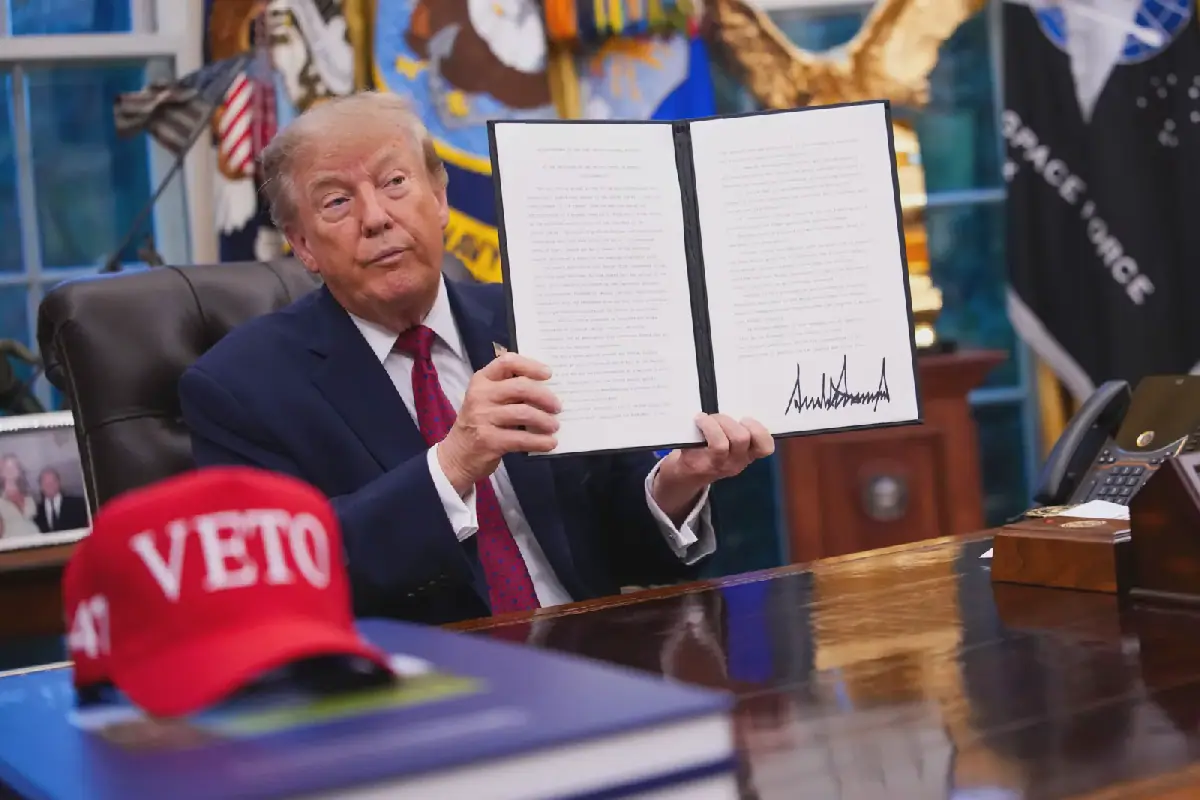
US President Donald Trump has signed a proclamation designating the Oval Office, the Outer Oval Office, and the Cabinet Room as a national monument. The move aims to shield these spaces from future alterations, with Trump's administration framing them as symbols of the presidency. The proclamation was signed on Thursday, following the midterm elections in which Democrats won enough seats to take control of Congress.
The proclamation invokes the Antiquities Act and places the three rooms under the management of the Secretary of the Interior, through the National Park Service. The designated areas include the Oval Office itself, listed as Room 110, along with Rooms 106 and 108, and the Cabinet Room, Room 105. A preservation plan will be developed, and any actions that would substantially alter or demolish the space will require review.
Trump described the order as a way to protect the Oval Office from being "touched by anybody, destroyed, ripped down by stupid people." He argued that the room, along with the White House, is a symbol of the presidency. The reason for acting now is not clear, as no move has emerged to tear down or dramatically alter either space. Trump cited the history of the two rooms, both sites of major international and domestic meetings, and both in the same locations since the 1930s.
However, the action carries narrower legal weight than Trump's remarks suggested. The proclamation states that nothing in it restricts the president's authority to redecorate, select furnishings, or make ordinary operational changes. A future president could also roll back the designation entirely. Trump himself has scaled back national monument protections before, as seen in July when he signed orders slashing the size of two national monuments in southern Utah.
The timing of the proclamation drew attention, as it came two days after Democrats won enough seats to take control of Congress. It marked the third consecutive day Trump devoted public remarks to his Washington construction projects. On Monday, he unveiled the refurbished Lincoln Memorial Reflecting Pool, and on Wednesday, he gave reporters a tour of the ballroom construction.
Preservation experts have questioned the value of the measure, with Greg Werkheiser of the law firm Cultural Heritage Partners noting that furniture and decor already fall under presidential discretion. Werkheiser called the order "hypocrisy," pointing to the administration's lawsuits against historic-preservation laws and its plans for a triumphal arch, which a federal judge has temporarily halted.
The order follows Trump's demolition of the White House East Wing, a project that proceeded without congressional approval and faces legal challenges. Construction continues on a new ballroom in that space. Senator Richard Blumenthal, the top Democrat on the Homeland Security Committee's Permanent Subcommittee on Investigations, has sent letters to donors funding the ballroom, demanding information or warning of "alternative measures to obtain compliance."
Key points
- The proclamation invokes the Antiquities Act to protect the Oval Office and Cabinet Room.
- Trump's administration frames the spaces as symbols of the presidency.
- The measure's impact is limited, allowing future presidents to redecorate or roll back the designation.
Reporting sources
- Read article: Trump Moves to Bar Future Presidents From Altering the Oval Office · Morocco World News