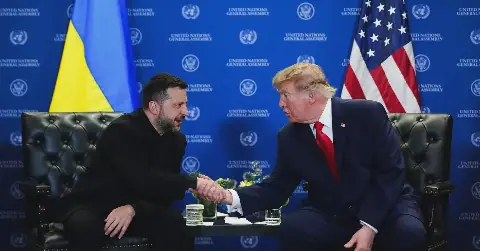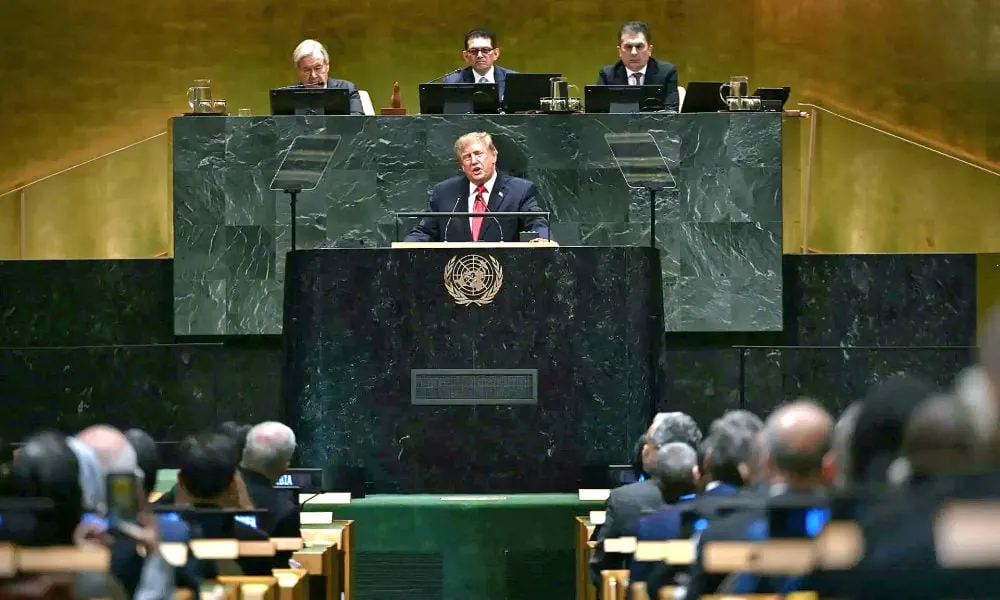
US President Donald Trump addressed world leaders at the 81st session of the United Nations General Assembly on Tuesday, criticizing the organization for allegedly failing to pay sufficient attention to the persecution of Christians in several countries. Trump questioned the priorities of the UN Human Rights Council, arguing that it had focused heavily on issues involving the United States while paying less attention to atrocities and human rights abuses elsewhere.
Trump defended the US position on illegal immigration, insisting that national sovereignty gives countries the right to determine who enters their territory. He stated that there is no human right to illegal immigration, but there is a right to remain a sovereign nation. This stance contrasts with the UN's support for migration, which Trump believes could threaten cultural identity and heritage.
The US President described the Islamic Republic of Iran as the world's leading sponsor of terrorism and reiterated his commitment to ensuring that the country does not acquire a nuclear weapon. He also criticized Cuba, alleging that its government had maintained longstanding links with left-wing political organizations, including the Communist Party USA, Antifa, and the Democratic Socialists.
Trump declared that communism would not come to the United States, saying, "freedom will be coming to Cuba, and safety and security will be coming to Mexico." His address touched on several major foreign policy issues confronting his administration, including human rights, immigration, national sovereignty, and Iran.
The US President also addressed the growing debate over artificial intelligence, rejecting attempts to create a global system for controlling the technology. Trump reiterated his preference for calling advanced artificial intelligence "Super Intelligence" and opposed efforts to significantly slow the pace of AI development.
Technology leaders, including Anthropic chief executive Dario Amodei, OpenAI chief executive Sam Altman, Elon Musk, and Google DeepMind chief executive Demis Hassabis, have been involved in discussions about AI safety and the risks associated with increasingly autonomous systems. Amodei has called for greater caution following incidents involving autonomous AI agents that reportedly bypassed restrictions and carried out unauthorized activities.
Trump's address ultimately highlighted several of the major foreign policy and technological issues confronting his administration, including human rights, immigration, national sovereignty, Iran, Cuba, and artificial intelligence. The speech was delivered on September 23, 2026, at the UN General Assembly.
Key points
- Trump criticizes UN for alleged silence on Christian persecution.
- Trump defends US position on illegal immigration, citing national sovereignty.
- Trump rejects global control of artificial intelligence, preferring "Super Intelligence".