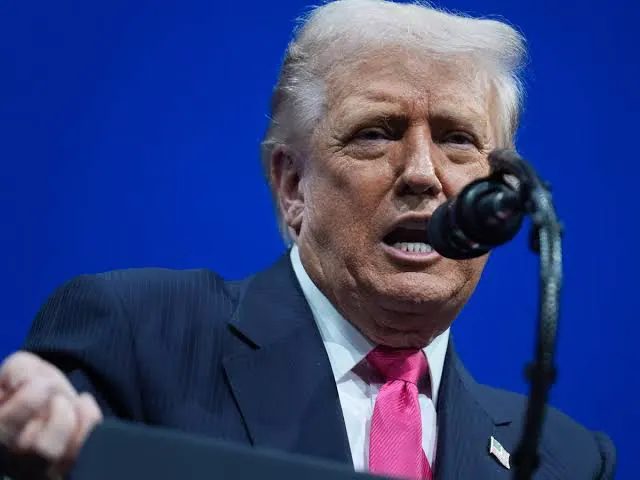
US President Donald Trump has attributed France's nationwide student protests to mass migration and Islam, downplaying the education-related concerns that sparked the demonstrations. In a post on Truth Social, Trump stated that the protests were not about schools, but rather about Islam seeking to take over France. This perspective contrasts with the actual reasons behind the protests, which began with high school students demanding better school conditions and resources.
The protests, which drew over 250,000 participants across France, according to official figures, have been ongoing since late September. Students have blocked entrances to hundreds of high schools, and some demonstrations have led to clashes with police. The movement's central demands focus on France's education system, with protesters calling for improved school conditions and increased resources. Trump's comments reflect a broader pattern in his administration's approach to social tensions in Europe, where migration has been a central theme in its criticism of European governments.
Trump's allies and prominent voices within the Make America Great Again (MAGA) movement have also used images of the French protests to advance their arguments about immigration and the future of Western societies. Conservative commentator Glenn Beck described the unrest as a "clear warning to the rest of the West," while right-wing commentator Dave Rubin shared footage of the protests and warned that similar scenes could emerge in the US if Democrats regain power. These comments come less than a month before the US midterm elections, with Trump and his allies emphasizing immigration and cultural issues.
The US president has long portrayed Europe as an example of the consequences of liberal migration policies. His administration has accused European countries of failing to protect their borders and preserve Western cultural identity. A US national security strategy released in December warned of "civilizational erasure" in Europe and pledged to support resistance to unfavorable political trends. Vice President JD Vance has also criticized European migration policy.
Paris has responded to Trump's comments, with French Foreign Minister Jean-Noël Barrot stating that France must present its own account of the protests rather than allow other governments to define the events. Barrot told a parliamentary committee that French diplomatic missions were working to ensure that France could "disseminate" its own account of the situation abroad. This response comes after Iran criticized France's handling of the protests and summoned the French envoy.
For French authorities and protesters, the immediate dispute remains focused on schools, with concerns about education resources, school conditions, and the broader pressures faced by students. The unrest has become part of a wider political debate, with figures on both sides of the Atlantic using the scenes in France to reinforce competing narratives about migration, social cohesion, and the future of Western societies.
The French protests have also drawn attention from other countries, with Iran summoning the French envoy over the government's response to the demonstrations. In contrast, the US and French perspectives on the protests highlight the complexities of international relations and the challenges of addressing social tensions.
Key points
- Trump's comments dismiss education grievances behind France's nationwide demonstrations.
- French Foreign Minister Jean-Noël Barrot seeks to counter foreign narratives on the protests.
- The protests reflect a broader debate about migration, social cohesion, and Western societies.