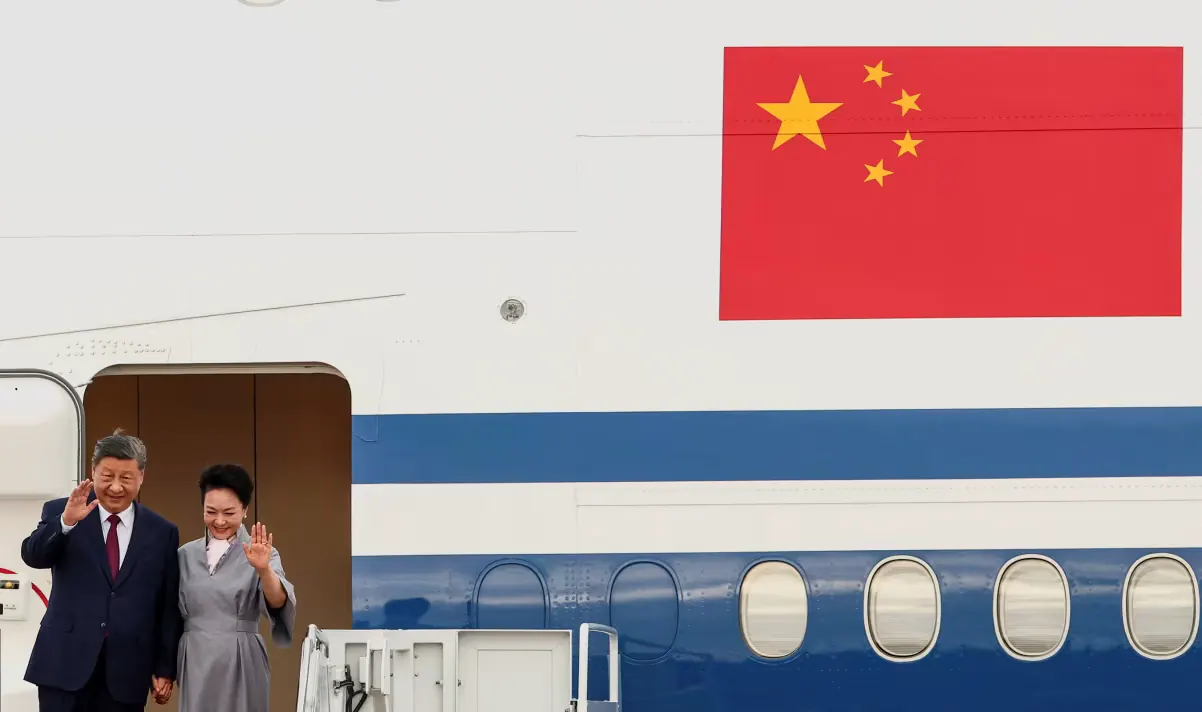
US President Donald Trump and Chinese leader Xi Jinping met at Joint Base Andrews on Wednesday, with Trump traveling to the foot of the steps to greet Xi at his plane. The two leaders chatted with their wives before strolling down a red carpet. Despite the lavish fanfare, expectations for a grand agreement on artificial intelligence and trade were low. The meeting was not expected to yield a significant agreement like the summits between President Ronald Reagan and Soviet leader Mikhail Gorbachev in the 1980s.
The US and China are pushing across a new technological frontier amid warnings from industry chiefs that artificial intelligence may soon race out of control. However, a good outcome from the summit would be limited to an extension of the bilateral trade truce and minor initiatives on AI, fentanyl flows, trade, and avoiding military clashes. The AI issue is especially emblematic of the gulf between the rivals, with each thinking it can prevail and resisting any meaningful constraints.
A personality mismatch between the improvisational Trump and the deliberate Xi also augurs against spontaneous decision-making. The US and Chinese political systems are so different that little common ground exists. Each side wants to avoid blowups but lacks the leverage to force concessions. Trump's plunging poll numbers amid the Iran war risk fraying his global clout, while Xi faces a property crisis and economic issues back home.
Most global summits under-deliver, and meetings between US and Chinese leaders unfold amid unflattering comparisons to epochal 1970s meetings between President Richard Nixon and China's Mao Zedong. Trump often gives the impression that he's more interested in the spectacle of global leader summits than their substance. His high-profile meetings with North Korean leader Kim Jong Un and Russian President Vladimir Putin produced little apart from photos.
Trump's determination to protect what he sees as his personal bonds with leaders sometimes leads him to make excuses on their behalf. He has taken faith in his own indispensability to new levels, boasting about his "great relationship" with Xi at 2024 campaign rallies. However, the Chinese leader rarely reciprocates with personal warmth toward Trump, showing every sign of playing a long diplomatic game.
Some Republicans have been critical of Trump's approach, with Sen. Roger Wicker, chairman of the Senate Armed Services Committee, blasting the meeting. Wicker described Xi as a "brutal, unelected and oppressive dictator" who seeks to dominate his neighbors. Former officials have said that Xi is more willing to engage in unscripted conversations in private than his predecessor Hu Jintao.
Despite the low expectations, Lyle Goldstein, senior fellow and director of the Asia Program at Defense Priorities, said the meetings were a "good thing" and that personal diplomacy between Xi and Trump had helped stabilize the relationship and reduced military tensions. The meeting may yield few concrete outcomes, but it is seen as a positive step in maintaining a fragile relationship between the two superpowers.
Key points
- The US and China are pushing across a new technological frontier amid warnings from industry chiefs that artificial intelligence may soon race out of control.
- A good outcome from the summit would be limited to an extension of the bilateral trade truce and minor initiatives on AI, fentanyl flows, trade, and avoiding military clashes.
- The meeting may yield few concrete outcomes, but it is seen as a positive step in maintaining a fragile relationship between the two superpowers.