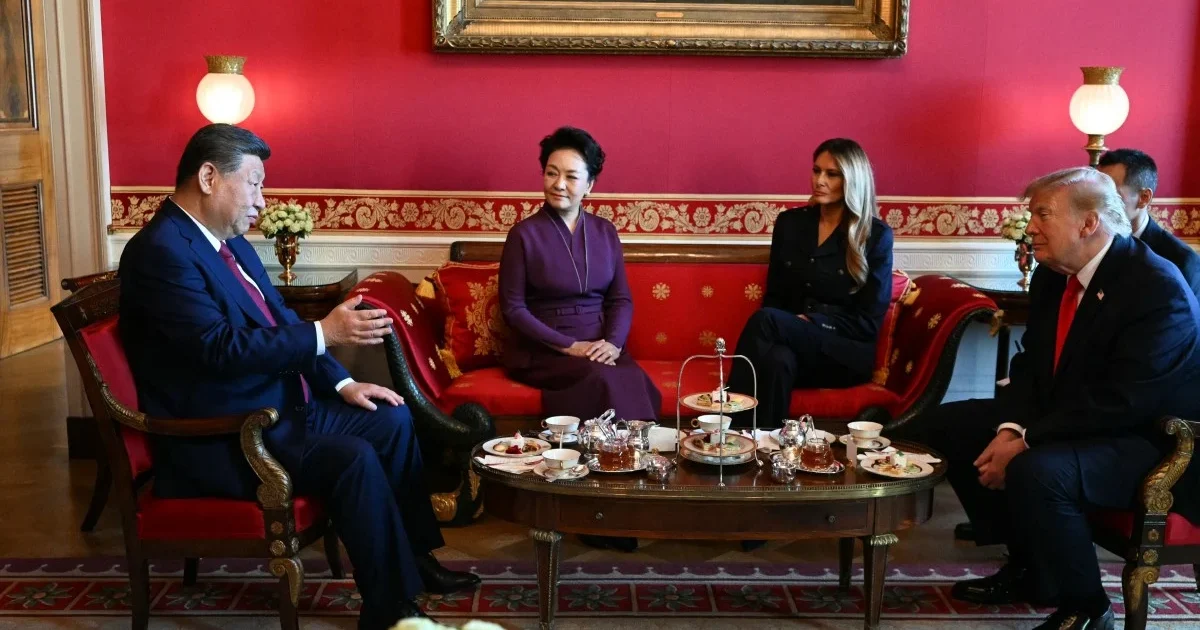
US President Donald Trump and Chinese leader Xi Jinping concluded their state visit on Friday with a tour of the National Archives in Washington, where they viewed the Declaration of Independence and the US Constitution. The visit was marked by pageantry, but yielded limited progress on key issues. Trump and Xi had discussed the Iran war, amid claims that Beijing is supporting Tehran, but hailed their "great" meetings despite a lack of concrete results.
The National Archives visit was a significant moment in the state visit, as it highlighted the 250th anniversary of the signing of the Declaration of Independence. Trump showed Xi the founding documents of US democracy, including the Constitution, which sets out the principles of US government. Trump noted that China's history dates back 6,000 years, while the US has a 250-year history, saying "We're very proud of our 250."
Despite the pomp and ceremony, the visit has been short on breakthroughs, with the two leaders apparently more interested in using the occasion to paper over deep tensions. Trump confirmed that he and Xi had discussed the Iran war, which is approaching its seven-month mark. China has continued to buy Iranian oil, and US media have reported that Beijing has supplied Tehran with intelligence for attacks on US troops.
Xi's visit has added "new substance" to his summit with Trump in Beijing in May, with the two leaders agreeing to "strategic stability on the basis of respect, fairness, and reciprocity." The Chinese leader also floated the idea of two more meetings with Trump this year, at the APEC meeting in Shenzen, China in November and the G20 summit at Trump's Doral resort in Miami in December.
Trump spoke in glowing terms about the visit, saying "I think we've made tremendous strides; we've made great strides, very positive for both countries." However, the only major announcements have been a shorter-than-hoped-for extension to the US-China trade truce and the imminent arrival of two pandas at a US zoo. The visit has been marked by controversy, including Trump's ban on three major US media outlets from the White House, which was lifted on Thursday.
The visit has also highlighted the differences between the US and China on issues such as press freedoms and human rights. Rights groups criticize China for its lack of press freedoms and the right of free expression, while Trump has showcased US democracy at the National Archives. The first amendment of the US Constitution proclaims the freedom of the press, which has been a point of contention between the two countries.
Xi departed Washington for Beijing on Friday, after a state banquet, military parades, a flyover, and a tour of Trump's new White House helipad. Despite the pageantry, the visit has yielded limited progress on key issues, and the two leaders still have significant differences to resolve. The US and China will continue to engage on issues such as trade and security, but the outcome of these efforts remains uncertain.
Key points
- Trump and Xi Jinping concluded their state visit with a tour of the National Archives, viewing founding documents of US democracy.
- The visit yielded limited progress on key issues, despite pageantry and ceremony.
- The two leaders discussed the Iran war, and Trump expressed optimism about the prospects for progress.