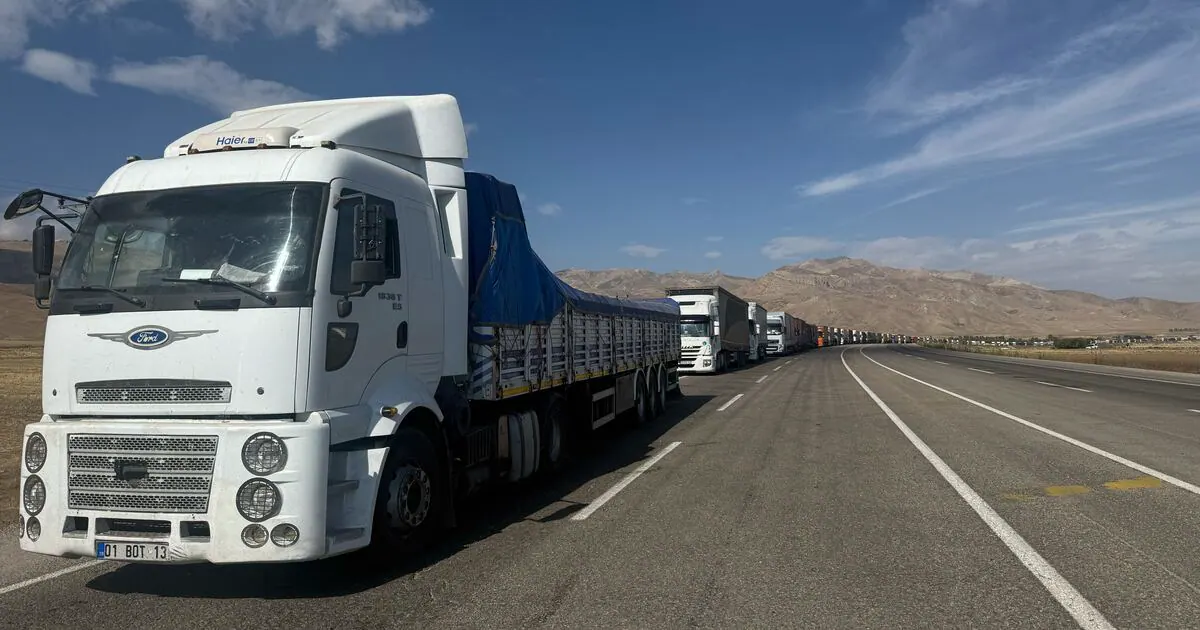
Hundreds of trucks are stranded along the road into Iran from Türkiye's eastern border, as the US navy blockade of Iranian ports forces Tehran to rely on overland trade. The blockade has severely limited most imports and cut off crucial oil and gas sales, which are the lifeblood of the Iranian economy. Iranian President Masoud Pezeshkian has emphasized the need to accelerate overland trade to mitigate the effects of the blockade.
The Türkiye-Iran border crossing, normally a bustling hub, is now a critical economic lifeline for Tehran. Iranian truck drivers, frustrated with the lengthy delays, have spoken out about the dire situation. Muhammed Rıza Shiri, a 55-year-old driver, has been waiting four days to carry his load of rubber into Iran, a wait time that has exceeded five days due to the blockade. Shiri's experience is not unique, as drivers report wait times of up to 25 days on the Iranian side of the border.
President Masoud Pezeshkian has accused the US of trying to weaken Iran, stating that Washington is "trying to create difficulties wherever they can" and "holding nothing back" in its efforts to pressure Tehran. Despite the pressure, Iran insists that it will not change its stance in negotiations with Washington. Tehran wants the US blockade to end before allowing commercial shipping to flow again through the Strait of Hormuz, a critical waterway that has shaken global markets and oil prices.
Iran faces significant challenges in shifting its trade from sea to land, as its economy previously relied heavily on the Gulf for over 80% of its trade. The country's land crossings with Türkiye to the west and Pakistan to the east are crucial in connecting with Europe and Asia. However, these crossings are badly strained, with logistics and capacities limited by regulations, border controls, and corruption. Economist Mohammad Farzanegan notes that overland trade "would not basically be able to substitute or compensate for the blockade".
The strain on land crossings is evident, with truck waiting times at Türkiye's Gürbulak border more than quadrupling since the war began. Data from the International Transporters Association shows that the number of trucks has surged, with 1,200 trucks currently waiting at the border, far exceeding the destination country's capacity. Iranian official Amir Roshanbakhsh Ghanbari attributes the backup to neighboring countries' reluctance to develop infrastructure, citing uncertainty about the situation's duration.
Iranian truck drivers are protesting the delays, which have significantly impacted their livelihoods. A Telegram channel linked to groups representing Iranian truckers and transportation drivers is flooded with messages protesting conditions, citing rising costs, increased maintenance expenses, and reduced cargo loads. Drivers like Akbar Sadigi, 42, report that longer waiting times have cut their trips in half, while fuel prices have risen by 25% in Iran since his last trip.
Iran and its neighbors are attempting to address the problem, with officials acknowledging the high stakes. The economy shrank by over 10% in the three months after the start of Iran's calendar year, while the non-oil economy shrank by 4.6%. The value of Iran's currency, the rial, has plummeted, and inflation has soared since the US and Israel launched their war on Iran. Officials report efforts to speed up border crossings, including increasing lanes at fuel measurement stations and doubling X-ray scanning machines.
Key points
- The US blockade has limited Iranian imports and oil sales, pushing Tehran to rely on overland trade through Türkiye and Pakistan.
- Truck waiting times at the Türkiye-Iran border have more than quadrupled since the war began, with drivers reporting wait times of up to 25 days.
- Iran's economy has shrunk by over 10% in the three months after the start of its calendar year, with the non-oil economy shrinking by 4.6%.