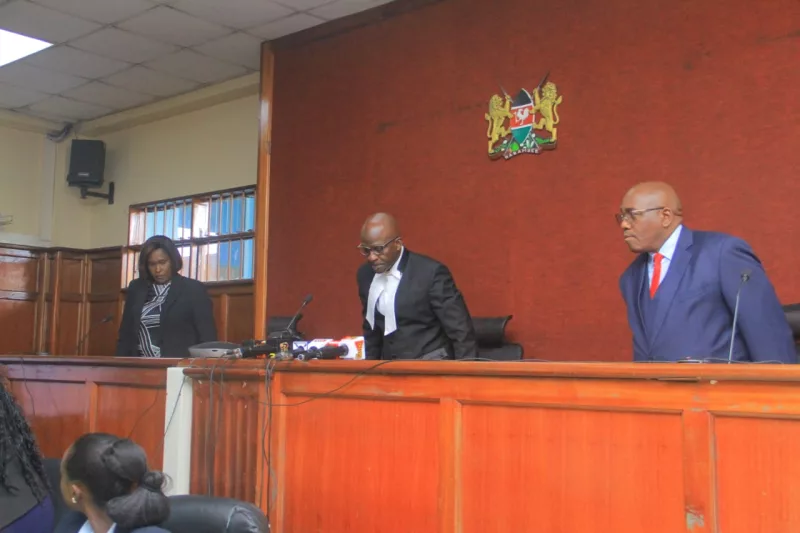
A businessman, Joseph Enock Aura, has asked the High Court to hear his petition challenging Prof. Kithure Kindiki's appointment as Deputy President in open court. Aura, through his lawyer Harrison Kinyanjui, argues that an open court hearing is necessary for a fair trial and public scrutiny. He filed a Certificate of Urgency and Notice of Motion, citing the massive public interest and wide media coverage that surrounded former Deputy President Rigathi Gachagua's impeachment.
Aura wants the court to cancel an order that the case be heard virtually on September 29 and 30 and instead hold the hearing in open court. He seeks orders to vary and set aside directions issued on June 18 and affirmed on September 22, requiring the determination of his petition virtually by written submissions on the two hearing dates. The petitioner argues that virtual proceedings would breach the constitution, citing court proceedings in the consolidated petition concerning Gachagua's impeachment.
The petition challenges Kindiki's appointment as Deputy President after Gachagua's impeachment. Aura says Kindiki was still Interior Minister when nominated, making his appointment unconstitutional. He maintains that no gazettement of Kindiki's cessation as a CS was ever made, violating Article 137(2)(b) of the Constitution of Kenya. Aura also cites the large number of advocates, network fluctuations, and past e-filing failures as reasons for an open court hearing.
Aura requested the Deputy Registrar on June 3 to provide multimedia and video-playing facilities during the open-court hearing. He needs to play online evidence from the National Assembly and Parliament, including video recordings, to demonstrate that Gachagua's impeachment and Kindiki's swearing-in were unlawful. The petitioner argues that isolating his petition to virtual online proceedings portrays the court as hiding the proceedings from the public.
The three-judge bench, comprising Justices Anthony Mrima, Eric Ogola, and Fredah Mugambi, had previously ruled that a virtual hearing was not inherently unfair. However, Aura argues that the court's previous decision was made without considering the current circumstances, and he has lost confidence in the bench's ability to hear the petition objectively. He asked the court to certify his application as urgent and suspend the September 29 and 30 hearing dates pending determination of the motion.
The judges had previously rejected an earlier request on September 22, ruling that the petitioner had not discharged the burden of establishing facts that would suggest bias on the part of any member of the bench. They also stated that Article 50(2)(d) of the constitution is about people accused of crimes and that Article 50(1) does not give anyone an absolute entitlement to dictate the mode in which the hearing is to be conducted.
The new request awaits a decision. Aura's petition is one of several cases challenging Kindiki's appointment as Deputy President. The court's decision will have significant implications for the country's constitutional processes and the role of the judiciary in ensuring transparency and accountability in public affairs.
Key points
- The petitioner, Joseph Enock Aura, argues that an open court hearing is necessary for a fair trial and public scrutiny.
- Aura challenges Kindiki's appointment as Deputy President, citing concerns that he was still Interior Minister when nominated.
- The court's decision will have significant implications for the country's constitutional processes and the role of the judiciary.