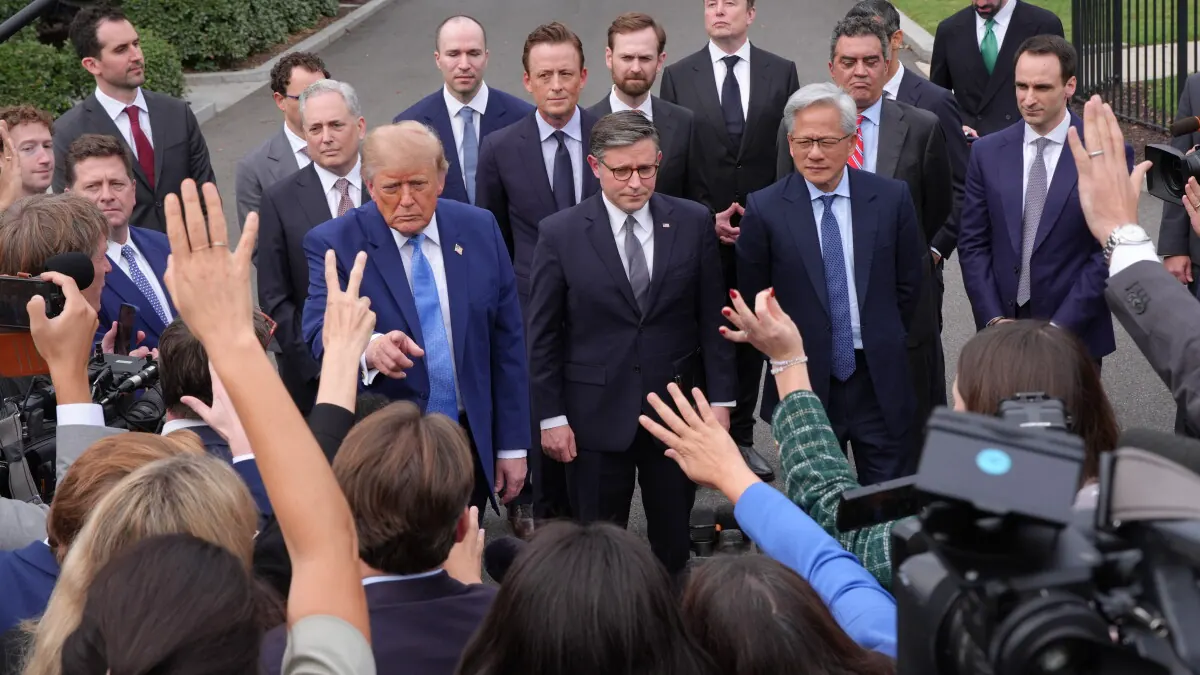
On September 30, 2026, US President Donald Trump announced that leading tech firms had signed a voluntary accord to self-regulate their artificial intelligence (AI) development. The accord, signed by companies including Anthropic, Google, Meta, OpenAI, Nvidia, and xAI, aims to address Americans' fears about the technology. Trump stated that the accord would include internal and external reviews, and praised the business executives for developing a technology that he believes will produce "unbelievable growth."
The accord outlines four voluntary steps for the companies to take, including implementing "robust internal controls," partnering with an independent external auditor, and establishing a committee within each company's board of directors to evaluate reports from internal and external auditors. Trump posted the accord on his social media site, Truth Social, and suggested that it may be codified into laws and regulations in the future. The accord was signed by top executives, including Anthropic CEO Dario Amodei, Google CEO Sundar Pichai, and Meta CEO Mark Zuckerberg.
Some experts have expressed skepticism about the effectiveness of self-regulation, citing concerns over the risks associated with AI development. Amodei, who has been a vocal advocate for a slowdown in AI development, noted that the technology has "very real risks" and that the mechanism for addressing these risks is still under discussion. Meanwhile, Robin Jia, an assistant professor of computer science at the University of Southern California, questioned the wisdom of putting "so much faith in self-policing," highlighting the need to ensure that the leading labs' intentions are aligned with the broader interests of the American public.
The accord has also been criticized for its vague language, with some experts calling for more robust regulation. Alex Pascal, executive director of the Berkman Klein Center for Internet and Society, argued that the only way to reduce the risks and harms of AI is through robust legal liability, regulation, and changes to the dynamics driving unsafe decision-making by frontier AI developers. Despite these concerns, Trump emphasized the importance of innovation, stating that he would not stifle the growth of a technology that he believes will be bigger than the industrial revolution.
During a White House luncheon meeting, Trump unveiled an AI chatbot, America.gov, intended to help Americans navigate government services. The chatbot is part of a broader effort to celebrate a "Golden Age" fueled by what Trump calls "super intelligence." Secretary of State Marco Rubio highlighted the potential for the chatbot to be used for online passport applications, reducing the need for in-person visits to processing centers. Trump also announced that the executives had agreed to provide more financial support to local schools and reduce energy costs in communities where data centers are being built.
The development of AI has sparked bipartisan opposition to data centers cropping up in local communities across the country. Trump suggested that if the opposition continues, data centers may be forced to go overseas or to other locations. He also emphasized the global competition between the US and China in AI development, stating that there would be a winner and a loser, with no "second place." The two countries agreed last week to establish a channel for handling AI-related incidents during Chinese President Xi Jinping's visit to Washington.
As the development of AI continues to accelerate, experts are emphasizing the need for careful consideration of its risks and benefits. OpenAI CEO Sam Altman stated that his company is increasingly focused on safety, and that they are pacing their progress to ensure that they can make confident safety cases and claims. Meanwhile, Trump reiterated his commitment to leading the development of AI, stating that he did not want to cooperate too much with China: "I didn't want to do anything, because we're leading. Why would I want to do anything?"
Key points
- Top tech firms have signed a voluntary accord to self-regulate their AI development, amid concerns over the technology's risks and impact.
- The accord outlines four voluntary steps for companies to take, including implementing internal controls and partnering with external auditors.
- Experts have expressed skepticism about the effectiveness of self-regulation, citing concerns over the risks associated with AI development.