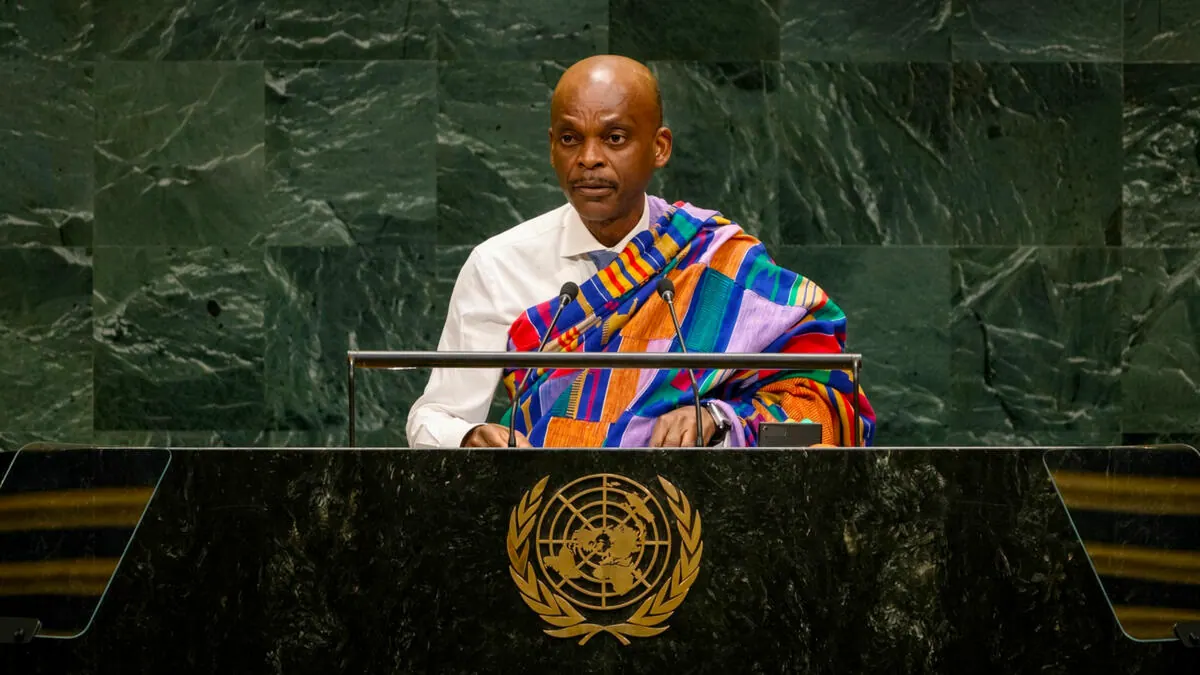
The Republic of Togo has once again marked its presence at the United Nations General Assembly, delivering a triple message focused on international law, mediation, and cartography. The West African nation took to the podium on September 26, 2026, to reiterate its concerns about the distortions in the world's cartography. Robert Dussey, the Minister of Foreign Affairs, represented Togo at the assembly, speaking on behalf of President Faure Gnassingbé.
During his address, Minister Dussey paid tribute to the outgoing UN Secretary-General, António Guterres, before diving into the crux of Togo's message: the urgent need to restore trust in multilateralism, which has been severely tested by the numerous violations of international law. He emphasized that international law is not a hindrance to power but rather guarantees its legitimacy, predictability, and stability. Dussey advocated for a pragmatic multilateralism that can translate commitments into concrete results.
A significant highlight of Dussey's speech was the adoption of the "Correct the Map" resolution on September 4, which was championed by Togo and approved by 164 votes. The minister stressed that correcting the map is not merely about rectifying geographical distortions but also about amending the perceptions it perpetuates. He noted that every time a past error is corrected, humanity gains in lucidity, justice, balance, and progress.
Building on this diplomatic success, Togo announced its intention to transition "from resolution to action" by proposing a new phase of international cooperation. This phase would bring together UN member states, UNESCO, cartographers, historians, educators, youth, and artificial intelligence stakeholders. The goal is to make cartography a more potent tool for knowledge, education, inclusion, and understanding among nations, especially in an era where digital maps shape the world's perception.
Minister Dussey called upon the international community, extending invitations to UN member states, international organizations, the scientific community, educators, innovators, and youth. He emphasized that the "Correct the Map" initiative is not a conclusion but a beginning – a new way of looking at the world. This ambition extends beyond the cartographic issue, reflecting a broader vision for global cooperation and understanding.
In addition to the cartography issue, Togo reaffirmed its commitment to dialogue and mediation in various regions, including West Africa, the Sahel, and the Great Lakes region. The nation underscored its belief that mediation is not a sign of weakness but a manifestation of responsibility. Togo also highlighted Africa's desire not to be acted upon but to have its efforts recognized, accompanied, and supported.
As the international community continues to grapple with issues of global cooperation, multilateralism, and the accurate representation of the world's geography, Togo's message at the UN General Assembly serves as a poignant reminder of the importance of collaboration, dialogue, and the pursuit of a more accurate and just worldview. The nation's endeavors in this regard have sparked a renewed focus on the interconnectedness of these issues and the collective responsibility to address them.
Key points
- Togo emphasizes the importance of international law in maintaining global stability and legitimacy.
- The nation advocates for a pragmatic multilateralism that delivers concrete results.
- Togo proposes a new phase of international cooperation to make cartography a tool for knowledge, education, and inclusion.