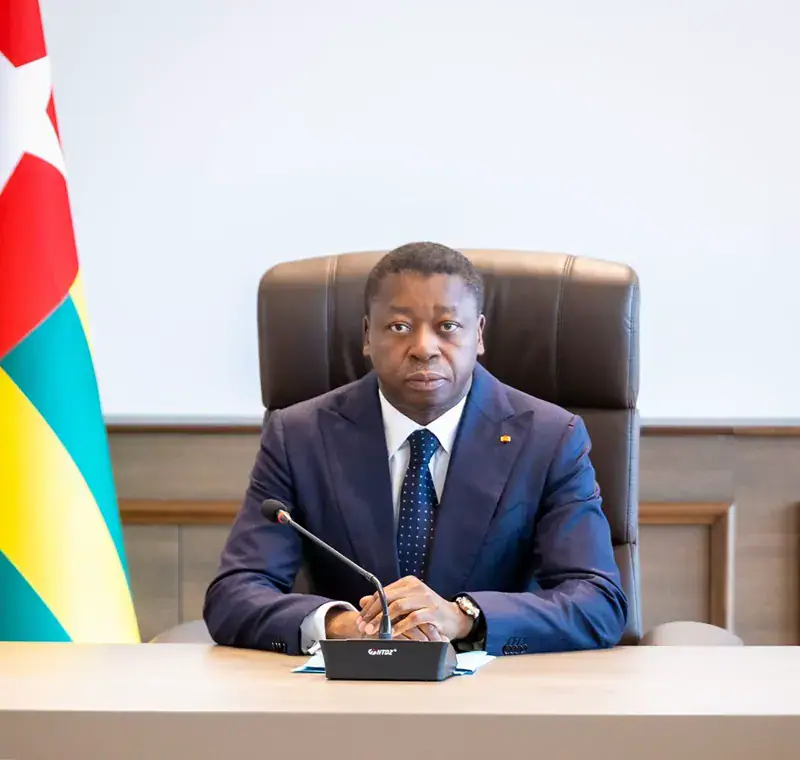
On October 22, 2026, Togo's Council of Ministers, led by President Faure Essozimna Gnassingbé, held a crucial meeting to address the nation's economic and legislative agenda. During the session, the Council examined and adopted four key bills, reviewed one decree, heard one communication, and made several nominations. These decisions aim to steer the country through a complex international economic landscape marked by geopolitical tensions and economic uncertainties.
The Council adopted the 2026 revised finance bill, which adjusts the state's budget to account for the evolving economic situation and its impact on public finances. The revised budget for 2026 stands at 2,744.2 billion CFA francs, a slight decrease of 0.3% from the initial 2,751.5 billion CFA francs. The projected budget deficit is 247.6 billion CFA francs, or 3.4% of GDP. These adjustments aim to mitigate the effects of rising hydrocarbon prices, reallocate resources to enhance anti-terrorism efforts, and secure more external financing for development projects.
Another significant decision was the adoption of the 2027 finance bill, which is set against a backdrop of global economic tensions and uncertainties. The proposed 2027 budget balances resources and expenditures at 2,684.1 billion CFA francs, a 2.5% decrease from 2026. This reduction is primarily due to the challenging international economic environment. The bill prioritizes national objectives such as security, social cohesion, economic transformation, access to basic social services, job creation, and support for vulnerable populations.
The 2027 budget allocates 490 billion CFA francs for investment in programs outlined in the government's 2026-2031 roadmap. These funds are distributed across three main axes: "Protéger" (Protect) with 227.2 billion CFA francs, "Transformer" (Transform) with 143.5 billion CFA francs, and "Rassembler" (Unite) with 97 billion CFA francs. Additionally, 22.4 billion CFA francs are dedicated to transversal programs. This strategic allocation aims to drive Togo's development and address pressing socio-economic challenges.
In addition to these budgetary measures, the Council of Ministers examined and adopted a decree and heard a communication. Although details of these discussions are not provided, they likely pertain to other critical aspects of Togo's governance and development strategy. The Council also made several nominations, which could involve key positions in the government or public sector.
The Council's decisions reflect the government's efforts to navigate the complexities of the global economy while addressing Togo's specific development needs. By adjusting the budget and outlining priorities for 2027, the administration aims to ensure economic stability and progress. These measures are part of a broader strategy to implement the 2026-2031 roadmap, which encompasses various initiatives to improve the lives of Togolese citizens.
The implementation of these budgetary and legislative measures will be closely watched by various stakeholders, including civil society, the private sector, and international partners. Their impact on Togo's economic trajectory and the well-being of its population will be significant. As the country moves forward, the effectiveness of these decisions in addressing pressing challenges will be crucial in determining the success of the government's agenda.
Key points
- The Council of Ministers adopted the 2026 revised finance bill and the 2027 finance bill, outlining budget allocations and priorities for the upcoming year.