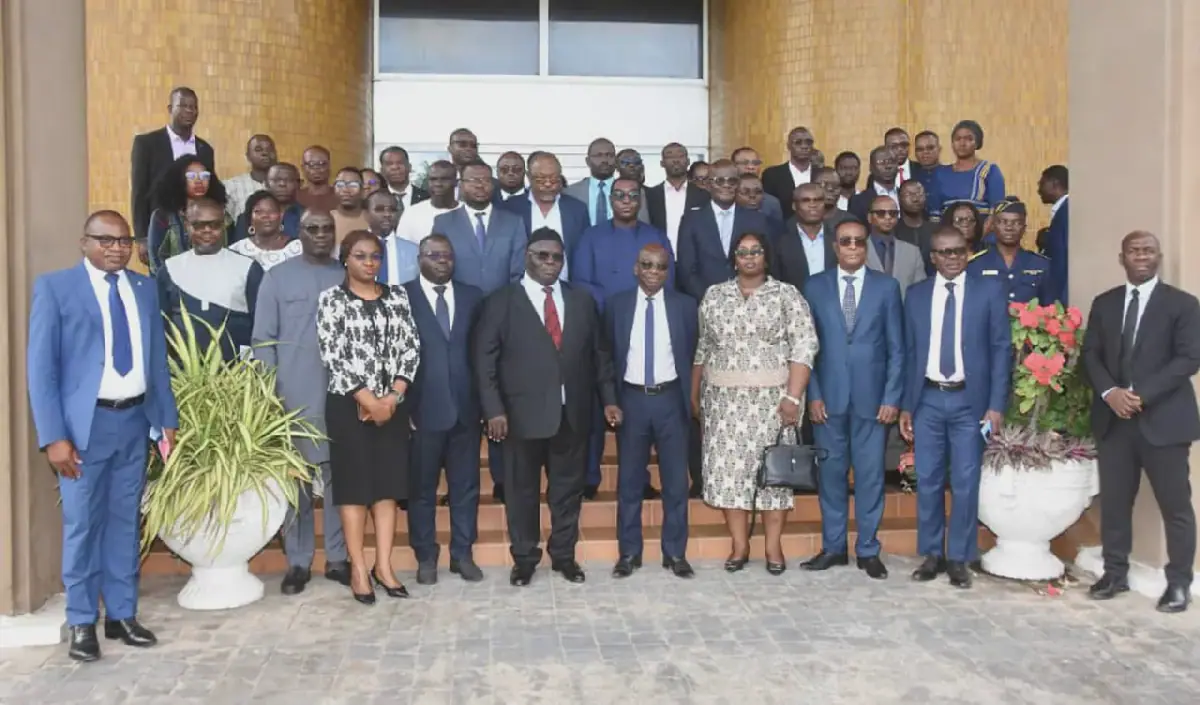
On October 22, the Cellule Nationale de Traitement des Informations Financières du Togo (CENTIF-TOGO) and national correspondent of the GIABA, held a national workshop to discuss and validate a report on the risks of money laundering linked to maritime crime. The event was opened by M. Tchaa Bignossi AQUITEME, President of CENTIF-TOGO, who emphasized the importance of collective action in combating money laundering, terrorism financing, and proliferation.
The workshop aligns with the high priorities set by President Faure Essozimna GNASSINGBÉ, who has made the fight against money laundering, terrorism financing, and proliferation a key aspect of public action. This aligns with his vision for 2026-2031, "Protéger, Rassembler, Transformer". A new law on money laundering and terrorism financing was promulgated in March 2026, in line with GAFI, GIABA, and UEMOA standards.
Togo has prioritized maritime security, hosting the African Union's extraordinary summit on maritime safety and security in Lomé in 2016, which led to the adoption of the Lomé Charter. Ten years later, the country remains committed to this goal, with President GNASSINGBÉ emphasizing the importance of securing the Gulf of Guinea during his official visit to China on October 11, 2026.
The national risk assessment of 2019 and the GIABA mutual evaluation of 2022 highlighted the need for a better understanding of the risks. Togo, due to its strategic location and the significance of the Port Autonome de Lomé, remains exposed to drug trafficking, smuggling, and illegal fishing, which are all vectors of dirty money.
To address these risks, CENTIF, with the support of CONAC and PAGDSP, funded by the African Development Bank, conducted a sectoral risk assessment related to maritime crime and five typology studies on corruption, wildlife trafficking, cross-border transportation of species, the real estate sector, and financial crime based on trade.
President AQUITEME outlined three requirements for the two-day workshop: strengthening a risk-based approach, consolidating cooperation, and ensuring operational effectiveness. He emphasized that no single administration has all the necessary information and that systematic information sharing is crucial at the national, regional, and international levels.
The workshop brought together 80 key actors, including ministries, BCEAO, Haut Conseil pour la Mer, Préfecture Maritime, Port, ANR, Police, Gendarmerie, Marine nationale, OTR, banks, insurance companies, and real estate sector representatives. The President of CENTIF expects concrete and prioritized recommendations from the workshop, going beyond mere observations.
Key points
- Togo's CENTIF is committed to combating money laundering and maritime crime.
- The country has taken significant steps to prioritize maritime security and strengthen its legal framework.
- The workshop aims to produce concrete recommendations to address the risks of money laundering linked to maritime crime.