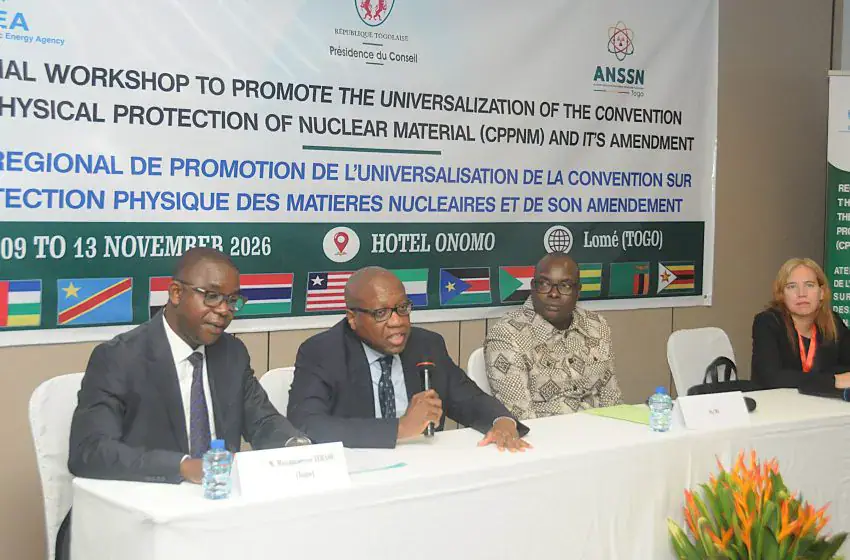
A regional workshop on promoting the universalization of the Convention on Physical Protection of Nuclear Materials (CPPMN) and its 2005 amendment kicked off in Lomé, Togo, on November 9, 2026. The event, organized by the Togolese Presidency of the Council and the International Atomic Energy Agency (IAEA), brings together national points of contact, senior officials, and nuclear security experts from 11 African countries. The five-day workshop aims to ensure technical understanding of the obligations under the amendment and develop national roadmaps for effective implementation.
The workshop was opened by Minister Delegate to the Minister of Economy, Energy, and Mining, Robert Koffi Messan Eklo, in the presence of Ministry of Security Secretary General, Commissioner Kadja Hodabalo. Eklo emphasized the growing importance of nuclear security in Africa, highlighting that nuclear energy presents a development opportunity for the continent, but requires rigorous safety and security guarantees. He noted that 44 of 54 African states have ratified the CPPMN, but only 30 have ratified the 2005 amendment, stressing the need for continued efforts.
The CPPMN, adopted in 1979 and entered into force in 1987, aims to protect nuclear materials and installations from illicit trafficking and terrorism. The 2005 amendment expands protection to nuclear material use, storage, and transport, as well as preventing sabotage. Eklo recalled that Togo has been a party to the Convention since 2006 and has strengthened its framework with the 2020 law establishing the National Nuclear Safety and Security Authority (ANSSN). The government has also initiated the process of adhering to seven nuclear conventions, including the CPPMN amendment.
IAEA representative, Roston Victoria, emphasized that the CPPMN and its amendment are the only legally binding instruments guaranteeing physical protection of nuclear materials and installations. She noted that while significant progress has been made towards universalization, more work remains to be done. The IAEA will continue to support states through seminars, workshops, and bilateral consultations to facilitate signature and effective implementation.
ANSSN Permanent Secretary, Mazamaesso Tchaou, highlighted that nuclear security is a concrete requirement for protecting populations, territories, and sustainable development. He noted that Togo's ANSSN ensures that activities involving nuclear materials and radioactive substances are conducted with safety and security in mind. As an IAEA member since 2012, Togo has established a regulatory framework aligned with international norms.
The Lomé workshop seeks to raise awareness among states, identify difficulties, and facilitate sharing of best practices and legislative assistance. Participants will engage in plenary sessions, case studies, and group discussions to develop national roadmaps with specific deadlines for adhesion and effective implementation. The event also aims to optimize synergies with other major instruments, such as UN Security Council Resolution 1540.
Togo's efforts in nuclear security have been recognized through its election to the IAEA Board of Governors for 2025-2027 and the organization of the Nuclear Innovation Summit for Africa in Lomé from June 1-3, 2027. The country's commitment to strengthening its nuclear security framework aligns with the government's 2026-2031 roadmap, "Protect, Gather, and Transform," led by President Faure Essozimna Gnassingbé.
Key points
- The regional workshop in Lomé aims to promote universalization of the CPPMN and its amendment among African countries.