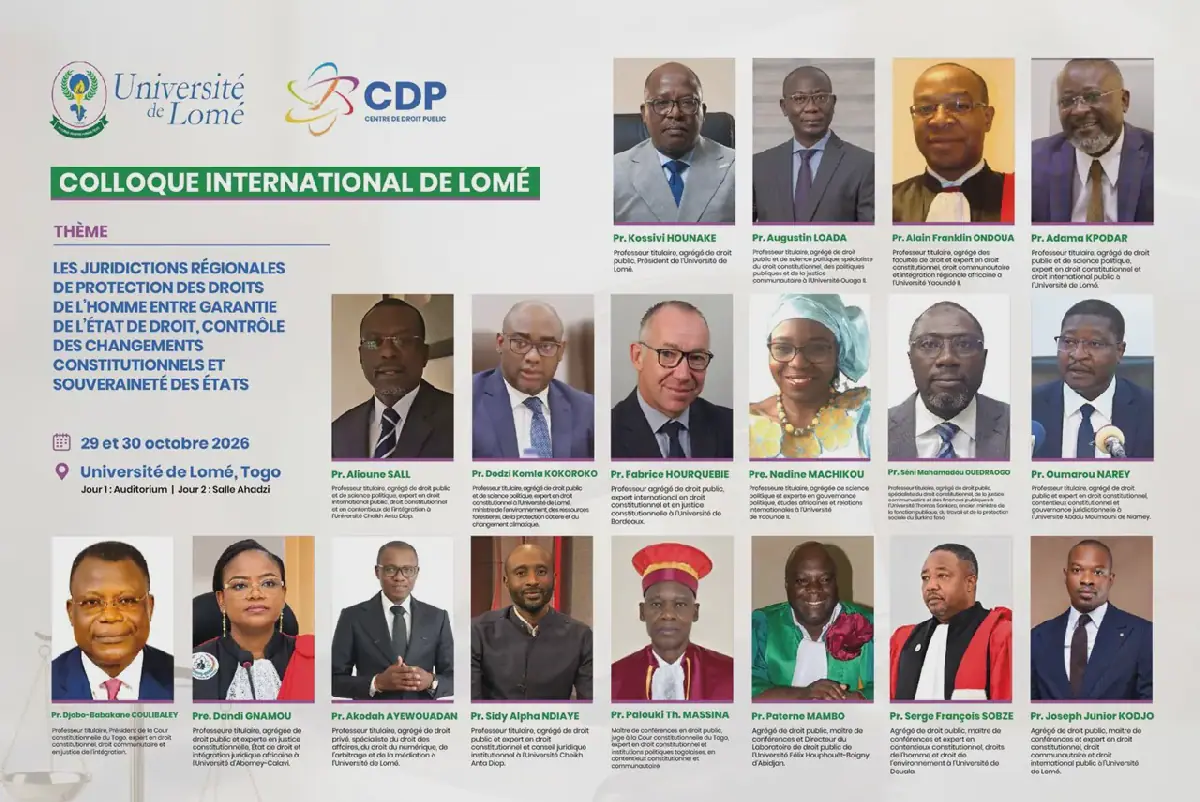
The University of Lomé is hosting a two-day international colloquium on regional African jurisdictions and their role in protecting human rights and monitoring constitutional changes. The event, which began on October 29, 2026, brings together jurists from the sub-region to discuss the role of regional jurisdictions. The colloquium is organized by the Center for Public Law at the University of Lomé and will feature discussions on the decision rendered by the ECOWAS Court of Justice on January 29, 2026, regarding Togo's constitutional reform of March 2024.
The ECOWAS Court of Justice ruled that Togo's constitutional reform violated Article 23 of the African Charter on Democracy, Elections, and Governance, and constituted an "unconstitutional change of government." The opposition has hailed the decision as a victory, with several organizations stating that the Court has judicially validated the illegitimacy of the Lomé government. However, the government has contested this interpretation, arguing that the Court has no competence to review the constitutionality of internal laws and that the instrument invoked can only be used by states.
The debate surrounding the ECOWAS Court of Justice's decision is more nuanced than the official statements. A political scientist notes that the Court is not a constitutional court and did not order the withdrawal of the 2024 law, but rather judged that the constituent power is not above international law. The colloquium will examine the role of regional jurisdictions in monitoring constitutional revisions, with a particular focus on the ECOWAS Court of Justice's decision.
The colloquium features a range of speakers, including academics from Benin, Burkina Faso, Cameroon, France, and Togo. The first panel, moderated by Professor Dodzi Kokoroko, will examine the regional judicial control of constitutional revisions, while the second panel, moderated by Professor Alain Ondoua, will discuss the execution of community court decisions between sovereignty and effectiveness.
On the second day of the colloquium, two roundtable discussions will focus on community protection of human rights, democracy, and the rule of law. The discussions will cover topics such as dialogue between judges, direct access to community jurisdictions for citizens and NGOs, and the application of democratic clauses and judicial independence.
The colloquium aims to bring together jurists, academics, and former public officials to discuss a question that affects West Africa: to what extent can regional courts frame the constitutional evolution of states? The general report will be presented by Professor Nadine Machikou from the University of Yaoundé II.
The event is being held at the University of Lomé's Koffi Ahadzi-Nonou hall and began at 9 am on October 29, 2026. The colloquium is expected to provide a platform for experts to share their insights and perspectives on the role of regional jurisdictions in protecting human rights and promoting the rule of law in Africa.
Key points
- The ECOWAS Court of Justice ruled that Togo's constitutional reform of March 2024 was unconstitutional.
- The colloquium aims to examine the role of regional jurisdictions in monitoring constitutional revisions.
- The event brings together jurists, academics, and former public officials from across West Africa.