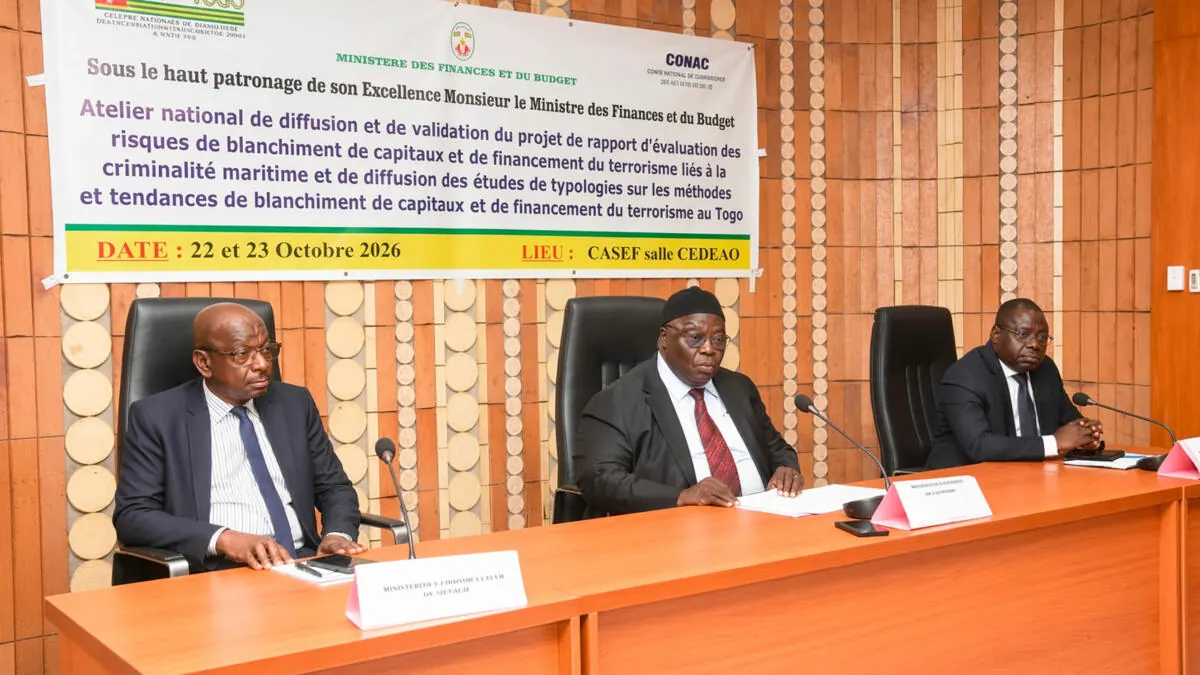
The Togolese government is strengthening its efforts to combat financial crimes, including money laundering and terrorism financing. A national workshop, which began on October 23, 2026, aims to evaluate the risks of these crimes linked to maritime crime and identify new methods used by criminal networks. The workshop, set to conclude on Friday, brings together various stakeholders to discuss ways to improve the country's response to these threats.
The workshop's objectives include better identifying threats, enhancing coordination among institutions, and defining new measures to prevent and combat illicit financial flows. Togo has made the fight against money laundering, terrorism financing, and proliferation a priority of its public action. This commitment is reflected in the adoption of new legislation in March 2026, which aligns with international standards set by the Financial Action Group (FATF), the GIABA, and the UEMOA.
Maritime security is a significant concern for Togo, whose economy heavily relies on port activities and commercial exchanges. In 2016, the country hosted the African Union summit, which led to the adoption of the Lomé Charter. The charter aimed to strengthen maritime security and combat illicit trafficking in the Gulf of Guinea. Togo is now seeking to enhance surveillance of its maritime spaces and combat illicit trafficking.
The workshop's participants have been tasked with three priorities: better identifying high-risk sectors, improving information sharing among national institutions and international partners, and increasing the effectiveness of investigations, prosecutions, and asset confiscation. The government expects the workshop to produce operational recommendations that will consolidate financial transparency and investor confidence.
The initiative has the support of the GIABA and the African Development Bank (AfDB). The workshop is being chaired by Tchaa Bignossi Aquiteme, president of the National Financial Intelligence Processing Cell (CENTIF), who is representing the Minister of Finance and Budget.
The Togolese government's efforts to combat financial crimes are part of a broader strategy to strengthen the country's financial system. By improving the regulation and supervision of financial institutions, Togo aims to prevent the misuse of its financial system for illicit purposes. The country's commitment to fighting financial crimes is also expected to enhance its reputation and attract more foreign investment.
The workshop's outcome is expected to contribute to the country's fight against financial crimes and enhance its maritime security. The government's proactive approach to addressing these threats is seen as a positive step towards creating a safer and more stable business environment in Togo.
Key points
- Togo holds national workshop to assess risks of money laundering and terrorism financing linked to maritime crime
- The workshop aims to evaluate risks, enhance coordination among institutions, and define new measures to prevent and combat illicit financial flows
- Togo has made the fight against money laundering, terrorism financing, and proliferation a priority of its public action