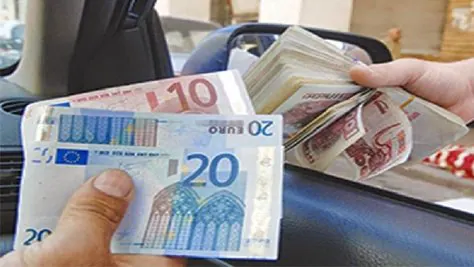
The parallel currency market in Tizi Ouzou, Algeria, has experienced significant fluctuations in the value of the euro since mid-July. After reaching record highs of 215 Algerian dinars (DA) per euro in late June and early July, the value dropped to 180 DA. Currently, the euro is trading at 193 DA on the parallel market. This instability has been attributed to various factors, including the balance between supply and demand.
According to an informal currency exchange operator in Tizi Ouzou, the recent decrease in the euro's value can be attributed to the strong supply of euros available on the informal market. The return of Algerian emigrants and the departure of major euro buyers, such as industrialists and businessmen, have contributed to this decrease. With fewer buyers, the market has become more favorable for sellers, leading to a slight decrease in price.
The exchange operator explained that during the period when the euro reached its peak value of 215 DA, the supply was limited, and demand was high due to various factors, including the hajj, commercial activities, and tourism. This imbalance led to a significant increase in the exchange rate. However, with the current abundance of euros on the market, the value has decreased.
When asked about the possibility of the euro's value increasing again in September, another exchange operator stated that it is likely. With the end of the summer vacation period and the return of businessmen and commercial operators, the demand for euros is expected to rise, potentially driving up the exchange rate.
The ongoing popular revolution that began on February 22 has also contributed to the instability of the parallel currency market. The uncertainty and caution among investors and importers have led to a wait-and-see approach, further affecting the market. As a result, the market is unlikely to stabilize until the situation improves.
Many holders of euros, particularly retirees, are choosing to wait and see if the value will increase in the future. A retired Algerian living in France stated that he has not exchanged his pension for two months due to the low exchange rates and is waiting for a potential increase in September.
The fluctuations in the parallel currency market have significant implications for the Algerian economy. The government's efforts to stabilize the market and control inflation are ongoing, but the situation remains challenging. As the market continues to experience fluctuations, individuals and businesses must adapt to the changing circumstances.
Key points
- The euro's value on Tizi Ouzou's parallel currency market has fluctuated significantly since mid-July, with a recent upward trend.
- The market's instability is attributed to factors such as supply and demand imbalances and the ongoing popular revolution.
- Many holders of euros are choosing to wait and see if the value will increase in the future, potentially driving up the exchange rate in September.