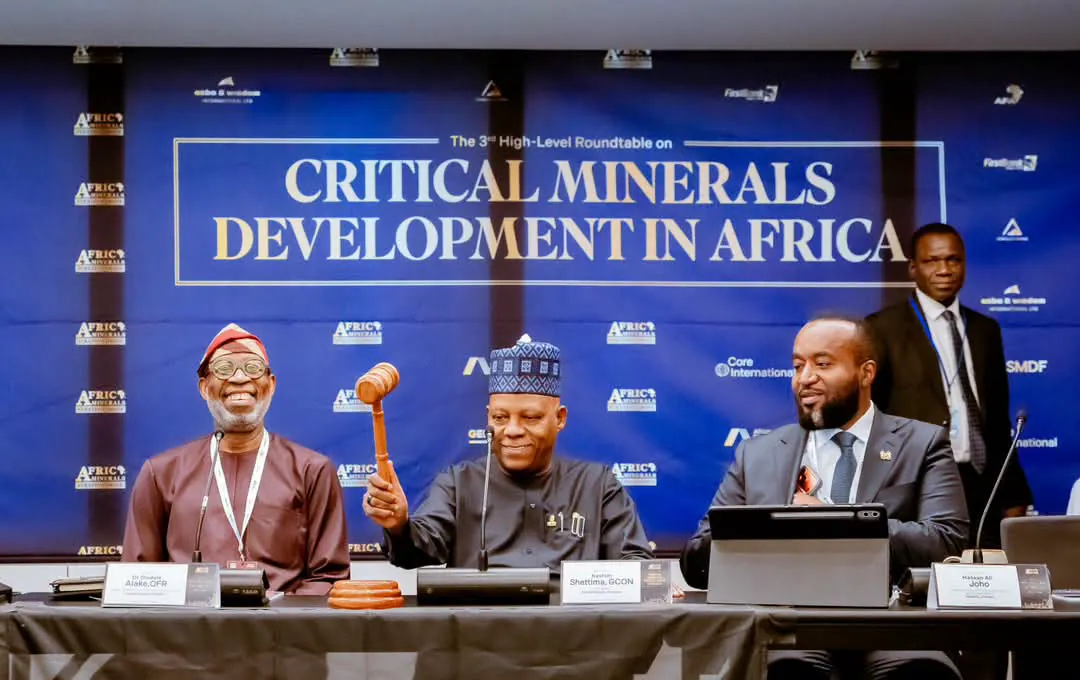
President Bola Tinubu has urged African countries to unite against the exploitation of their mineral wealth, emphasizing the need for local processing and value addition. Speaking at the 3rd Africa Minerals Strategy Group (AMSG) High-Level Roundtable on Critical Minerals Development in Africa, Tinubu, represented by Vice-President Kashim Shettima, stressed that Africa could not claim to be wealthy while its mineral-rich communities lacked adequate infrastructure, jobs, and meaningful participation in the wealth generated from their natural resources.
The roundtable, convened by President Tinubu and chaired by Nigeria's Minister of Solid Minerals Development, Dr. Dele Alake, focused on strategies for transforming Africa's vast mineral resources into sustainable economic growth, industrial development, jobs, and shared prosperity. Tinubu challenged African leaders and stakeholders to unite against a system in which the continent exports raw minerals only to import finished products at premium prices. He declared that Africa's duty was to ensure that the future being fashioned from African minerals had room for African ambition.
Tinubu noted that the urgency for change had increased with rising global demand for critical minerals driven by clean energy, artificial intelligence, and advanced manufacturing. He stressed that Africa must seize the opportunity to build industries and retain greater value from its resources. According to him, the answer to the continent's mineral paradox lay in processing, refining, batteries, components, African technologies, and competitive skills.
The President warned that no African country could achieve the desired transformation in isolation, arguing that competition among countries through lower royalties, weaker local-content requirements, and excessive concessions would undermine the continent's collective bargaining power. He emphasized that cooperation would give African markets scale, industries integration, financing reach, and negotiations authority. Tinubu highlighted Nigeria's ongoing mining reforms, which now required local value addition for new mining licenses.
Tinubu disclosed that government revenue from Nigeria's mining sector had risen significantly, from approximately N6 billion in 2023 to over N38 billion in 2024, and to between N68.1 billion and N70 billion in 2025. He pointed to major foreign investment commitments and the development of large-scale lithium processing capacity in Nasarawa State as evidence of the possibilities presented by the reforms. The President maintained that the policy direction of his administration was clear: minerals extracted in Nigeria must contribute to Nigerian industries, workers, skills, and communities.
The President urged African countries to speak with one voice in negotiating market access, industrial investment, and technology partnerships that would strengthen indigenous capabilities. He called for the effective implementation of the Continental Integration and Economic Assurance Declaration (CIEAD), adopted and signed at the roundtable, stressing that the declaration must go beyond a ceremonial commitment. Tinubu urged member countries of the AMSG to define their national and regional contributions.
Tinubu emphasized that Africa's power resided in its people, markets, and ingenuity, and that no outsider would organize the continent or place African industrial interests above their own. He concluded that minerals conferred no automatic prosperity; vision, investment, and industry must earn it, and that political will must turn mineral promise into enduring African wealth.
Key points
- President Tinubu calls for African countries to unite against exploitation of mineral wealth.
- African countries urged to stop exporting raw minerals and move towards local processing and value addition.
- Nigeria's mining reforms lead to significant increase in government revenue.