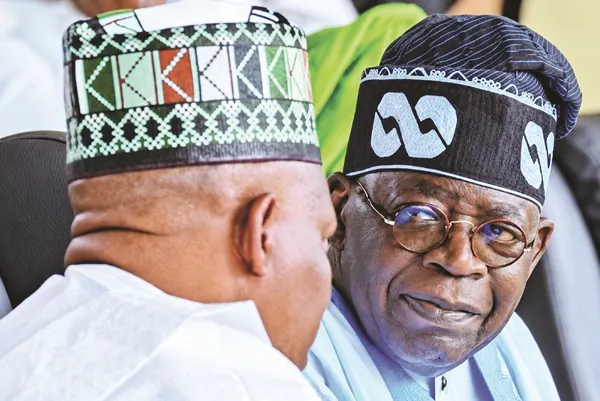
In a significant display of diplomatic prowess, Nigeria's Vice President Kashim Shettima has completed a series of high-stakes engagements across Africa and beyond, championing the country's interests and redefining its role on the global stage. At the 81st Session of the United Nations General Assembly, Shettima delivered a performance that redefined deputyship in Nigerian foreign policy, passing a crucial test of loyalty and competence. His shuttle diplomacy took him from Luanda to New Delhi and finally to New York, where he carried the voice of President Bola Ahmed Tinubu and the pride of Nigeria.
Shettima's first stop was Luanda, Angola, where he attended the 21st Extraordinary Session of the Assembly of Heads of State and Government of the African Union. There, he tabled a motion expressing concern over recurring xenophobic and Afrophobic attacks in South Africa, stressing that such incidents undermine African solidarity and require urgent collective attention. This move marked a significant shift in Nigeria's approach, as it formally requested that the matter be placed on the agenda of the 40th Ordinary Session in January 2027 for appropriate action. This formal referral moves the issue from social media trends into the official African Union archives.
From Luanda, Shettima proceeded to New Delhi, where he participated in the 18th BRICS Summit. The message was clear: the outdated rules of global governance must be rewritten to reflect today's economic and demographic realities. Nigeria positioned BRICS not as an anti-West bloc, but as a lever to amplify the agency of the Global South. Shettima invited investors to view Nigeria as the gateway to the AfCFTA, redefining resilience as an economy that withstands shocks while creating opportunities. He also emphasized the need for Nigeria to produce technology, create knowledge, and own intellectual property.
Shettima's next stop was New York, where he delivered a series of high-profile addresses, synthesizing Nigeria's diplomatic efforts across various platforms. At the General Debate, he demanded that Africa no longer fill the UN Security Council agenda from the margins, insisting on two permanent seats with veto power plus five non-permanent seats, per the Ezulwini Consensus and Sirte Declaration. He also framed warfare, debt, and climate change as symptoms of the same dysfunction, emphasizing the need for reformed multilateralism.
During his engagements, Shettima drew on Nigeria's experiences, including its fight against Boko Haram and ISWAP, to argue that no nation secures itself alone. He presented reformed multilateralism not as a choice, but as an absolute security necessity. The Vice President also met with United Nations Deputy Secretary-General, Hajiya Amina J. Mohammed, reaffirming Nigeria's support for urgent reform of the United Nations.
Throughout his engagements, Shettima carried the vision of President Tinubu without dilution, emphasizing the need for Africa to be taken seriously on the global stage. He cited initiatives such as 3MTT training three million talents, Project BRIDGE expanding broadband, and national AI programmes for an open, secure, and inclusive digital ecosystem. These efforts reflect Nigeria's commitment to technological advancement and its role in shaping the future of the continent.
The outcomes of Shettima's diplomatic efforts have been hailed as significant, reflecting a coherent doctrine that insists Africa can no longer be lectured about development while being denied tools to develop. The Vice President's performance has redefined the role of Nigeria's deputy president, demonstrating intelligent loyalty and competence on the global stage. As Nigeria continues to navigate complex international relationships, Shettima's efforts have set a new benchmark for diplomatic engagement.
Key points
- Nigeria's Vice President Kashim Shettima champions African interests at key international gatherings.
- Shettima's diplomatic efforts yield significant outcomes across Africa and beyond.
- Nigeria redefines its role on the global stage, emphasizing the need for reformed multilateralism.