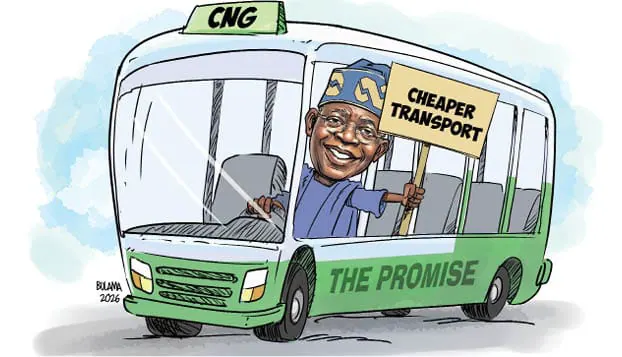
President Bola Ahmed Tinubu's promise to reduce transport costs across Nigeria by October 1 may be challenging to meet, as many states have made little to no progress in implementing the necessary infrastructure. Tinubu had announced in late August that governors had agreed to adopt Compressed Natural Gas (CNG) and electric vehicles in the public transport system to reduce costs. However, checks by correspondents reveal that several states have no CNG stations or conversion facilities.
According to findings, many states have only one or two CNG stations, while others have none. The Presidential Initiative on Compressed Natural Gas (Pi-CNG) has converted over 120,000 vehicles nationwide, with more than 100,000 additional conversion kits in the works. President Tinubu also directed the rollout of 500 CNG refuelling stations nationwide, bringing the programme to 1,000 stations across the country. However, experts believe that more needs to be done to make the CNG project a success.
Experts stress that governments at all levels must invest in the provision of CNG filling station centres and conversion infrastructure for the project to work. They also emphasize the need for special attention to be given to the conversion of trucks and articulated vehicles that transport essential goods. Baffah Saleh Yusuf, a transport engineer, expressed doubts about meeting the October 1 deadline, citing the millions of vehicles currently running on petrol and diesel.
Checks by correspondents in some states reveal a lack of progress in implementing the CNG programme. In Taraba, Benue, and Plateau states, there are no functional CNG refuelling stations or conversion centres. Taraba State Commissioner of Transport, Mr. Yakubu Sumuila, confirmed that the state has not kick-started any process concerning the CNG and electric vehicles programme, citing the absence of gas pipelines and lack of gas supply.
In contrast, the Benue State Government claims to be putting infrastructure in place for a proposed CNG centre in Makurdi. The state has a solar-powered vehicle station operated by the Benue Investment and Property Company Limited (BIPC), which unveiled its first batch of electric and solar-powered vehicles last year. The state government says it is working on several measures, including CNG vehicle conversion and public awareness, to implement the federal government's initiative.
The Technical Adviser to the Benue State Governor on Natural Gas and Renewable Energy, Jonathan Ashir, said the state is working towards making CNG available, with a three-day awareness workshop scheduled in Makurdi. Ashir also disclosed that discussions are ongoing with Greenville Energy Solutions to establish a CNG facility in Makurdi, with 5,000 CNG kits secured for the state. The state aims to roll out the first 100 vehicles for the pilot phase by October 1.
With Nigeria having an estimated 11 million to 14 million vehicles traversing its roads, the success of the CNG project will require concerted efforts from governments at all levels. As the October 1 deadline approaches, it remains to be seen whether many states will meet the target of reducing transport costs through CNG and electric vehicles.
Key points
- Many Nigerian states may not meet President Tinubu's October 1 deadline to reduce transport costs through CNG and electric vehicles.
- The Presidential Initiative on Compressed Natural Gas (Pi-CNG) has converted over 120,000 vehicles nationwide.
- Experts stress that governments must invest in CNG filling station centres and conversion infrastructure for the project to succeed.