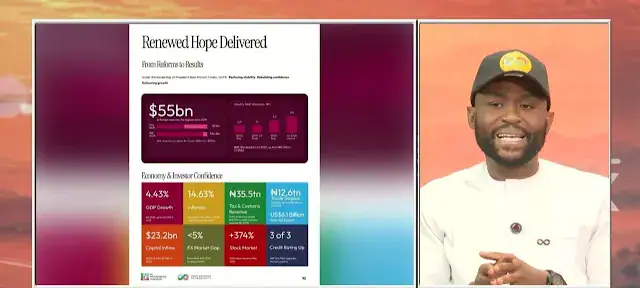
A group supporting President Bola Tinubu, the Data Analytics Group for Asiwaju (DAGFA), has appealed to Nigerians to give the economic reforms more time to improve household earnings. DAGFA spokesperson Niyi Sodipo made the appeal on the Arise News Daybreak program. He discussed the APC manifesto for the 2027 presidential election, unveiled on November 10. The group acknowledged that many Nigerians are still facing hard times.
Sodipo argued that the economic reforms introduced by Tinubu since 2023 have helped stabilize the economy. However, he acknowledged that the government still has work to do before stability translates to more business, employment, and better living conditions. He described the economic reforms as "a means to an end, not the end itself." The next task, he said, is to ensure that the improvements reach business owners, workers, and their families.
The discussion followed the unveiling of the All Progressives Congress (APC) manifesto for the 2027 presidential election. One major question is whether the government has enough money to fund its programs while paying debt and meeting other spending obligations. The presenter pointed to the first-quarter budget figures, which show that debt service takes up about 91% of federal revenue. They asked how the government plans to fund development alongside debt payments and regular running costs.
According to BusinessDay analysis of the Budget Office's first-quarter 2026 report, the federal government collected ₦5.08 trillion between January and March, against a target of ₦9.22 trillion. Debt-service spending for the same period reached ₦4.63 trillion. The quarterly report also recorded ₦1.69 trillion in capital releases, although this amount falls well below the projected allocation. The revenue that came in amounts to about 55% of the quarterly target.
Sodipo acknowledged that debt-service costs need attention but argued that people should also examine what the government is using borrowed money for. He maintained that "debt is not a problem for us right now" and referred to the International Monetary Fund (IMF) assessment to defend his position. The IMF's 2026 assessment rated Nigeria's overall risk of sovereign stress as moderate. The report identified weak revenue collection and the risk of spending exceeding planned limits as concerns.
The issue of how government figures affect ordinary families was also discussed. The presenter asked Sodipo to name one reform that has directly benefited a low-income family, apart from the Nigerian Education Loan Fund (NELFUND). Sodipo mentioned petrol subsidy removal and improved fuel availability. When questioned about stable petrol prices, he shifted the emphasis to the absence of scarcity as the main benefit. He also mentioned government payments to vulnerable Nigerians.
Sodipo used his own company as an example to explain how businesses can pass on benefits to families. He said that despite the reform period, his company continues to employ workers and argued that growing businesses can support household income through salaries. The discussion also touched on the cost of borrowing, with the presenter asking how small businesses can expand when high interest rates make loans expensive.
Key points
- The group supporting President Bola Tinubu is asking Nigerians to give the economic reforms more time to improve household earnings.
Reporting sources
- Tinubu grup ask for more taim on rifom · Prime 9ja Online