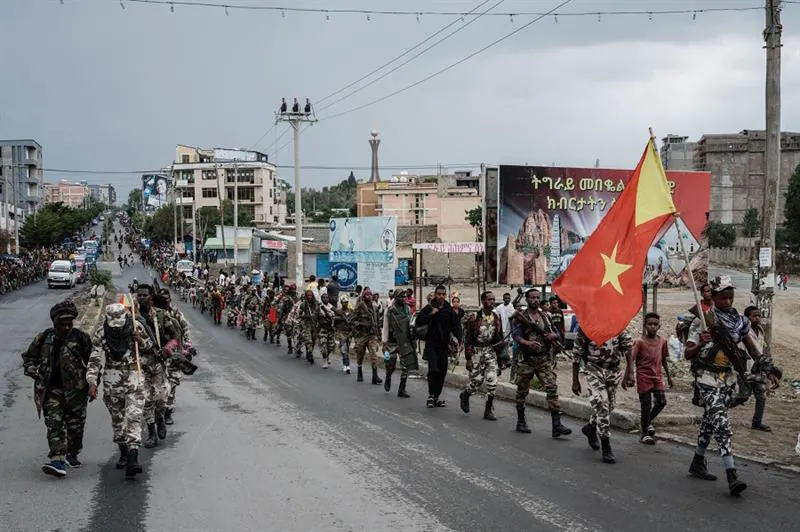
Heavy clashes have erupted across three main regions in northern Ethiopia: Tigray, Amhara, and Afar. According to Mohamed Hussein, head of the ruling party in Afar, Tigray forces have seized three towns in the region, specifically in Areas 2 and 4. Hussein urged the federal government to take responsibility for protecting Afar residents, stating that regional forces have all options open to defend their territory.
The Afar region holds significant strategic importance due to its borders with Djibouti and Eritrea, raising concerns that the fighting could disrupt trade across the region. The clashes between Afar forces and the Tigray People's Liberation Front (TPLF) are taking place along an 80- to 90-kilometre front. The conflict has now spread across three Ethiopian regions with a combined population of over 38 million people, sparking fears of a regional war.
The TPLF has allied with six other armed groups to overthrow the government of Prime Minister Abiy Ahmed. An eighth group, the Sidama Liberation Front, based in southern Ethiopia, has also joined the alliance. Analysts believe the TPLF is repeating its strategy from the last war, pushing south through Amhara toward the capital, Addis Ababa. The offensive in Afar aims to cut off supplies from Djibouti, which provides almost all of Ethiopia's international trade cargo, including fuel.
The Ethiopian government has a significant military advantage, with a large arsenal of drones, an army of around 500,000 troops, and external support. Clionadh Raleigh, head of conflict monitor ACLED, stated that while it's not yet an all-out war, she sees no "brakes in the system that prevent it from escalating further." Raleigh added that she doesn't expect the conflict to return to a low-intensity conflict, given the many interests involved.
In Tigray, residents are rushing to buy alternative SIM cards as phone networks and the internet experience near-total disruption. Many are terrified of a repeat of the blockade imposed during the civil war in 2020-2022, which had a devastating impact on the region. The UN rights chief, Volker Türk, warned that internet and telecommunications interruptions are increasing the risks to Ethiopians posed by the conflict.
The conflict has already led to panic buying in Tigray, with prices for basic goods spiking as locals stock up on supplies. Samuel Gebreslassie, a resident of Mekelle, expressed deep fear that banks, telecom networks, electricity, and basic goods could be cut off again. The international community, including the US, has expressed concern over the escalating violence, with the US embassy siding with Ethiopia's government and condemning the TPLF offensive.
Key points
- The conflict has spread across three Ethiopian regions, affecting over 38 million people.
- The TPLF has allied with seven armed groups to overthrow the government of Prime Minister Abiy Ahmed.
- The conflict has led to disruptions in trade, communication, and basic services, sparking fears of a humanitarian crisis.