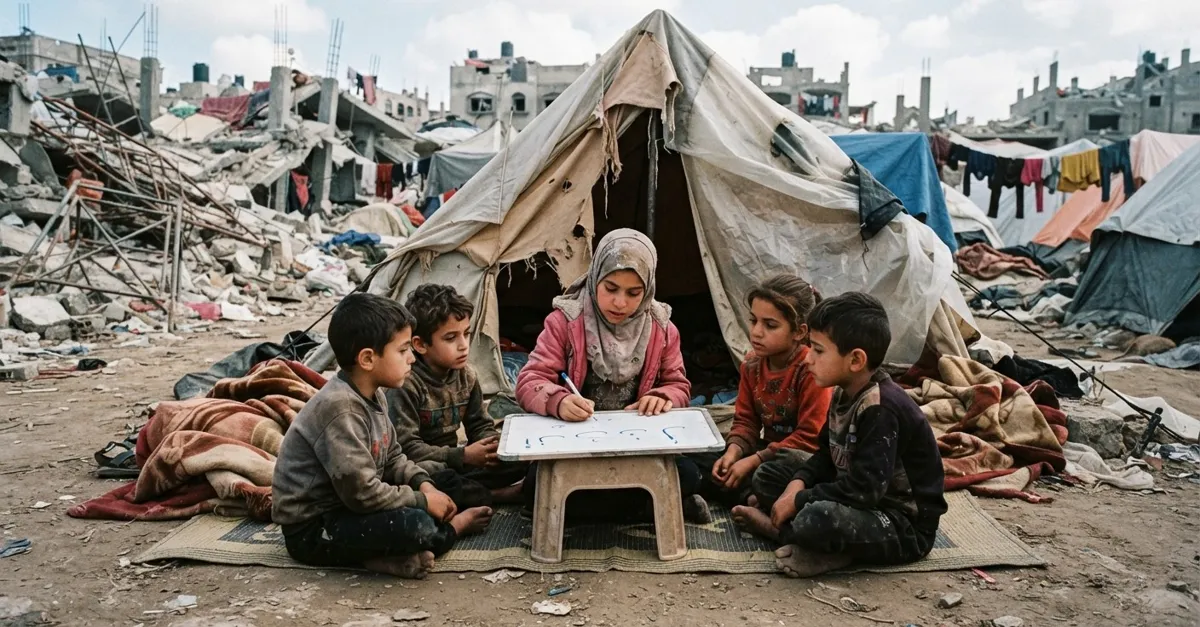
In the southern Gaza city of Khan Yunis, 12-year-old Palestinian student Haya Shukri Sarhan stands amidst the ruins of her memories, recalling the beginning of her middle school journey at Zahra Middle School. However, her academic life was disrupted just a month into the new school year with the outbreak of war, forcing her to flee and disrupting her education. Haya has been displaced three times to the Mawasi area, experiencing exhaustion and mental distress due to repeated displacement.
According to Sadq Al-Khudour, spokesperson for the Palestinian Ministry of Education, the education sector in Gaza has suffered extensive damage over the past three years, affecting schools, universities, educational staff, and students. He stated that over 90% of government school buildings in Gaza have been damaged, with 273 buildings severely damaged and 40 partially damaged. Many schools have been converted into shelters for displaced persons, limiting the ability to provide a stable learning environment.
The shift to online education for Gaza students was insufficient to bridge the educational gap, according to Haya. She described the experience as ineffective, citing difficulties in focusing on lessons while dealing with fear and instability. The Ministry of Education attempted to implement virtual education, with around 350,000 students enrolled at its peak, but many students were unable to access these programs due to displacement or injury.
The loss of educational infrastructure and personnel has been devastating, with over 6,000 teachers and staff displaced or losing their jobs, and nearly 800 educators killed in schools. Additionally, around 20,000 students have been killed, and many more injured, with over 3,000 students with disabilities. The Ministry of Education must now provide special programs for psychological support, social services, and educational adaptation for students who have experienced trauma.
Currently, around 700 educational points are operating, offering classes in three shifts per day, with students receiving approximately 12 hours of instruction per week, down from 30 hours before the war. The Ministry has adopted a system of educational packages, focusing on core subjects and skills to compensate for lost learning. However, around 30,000 students remain unaccounted for and have not returned to education.
Rebuilding Gaza's education sector will require significant investment, with estimates suggesting a need for at least 500 schools and $1.5 billion in funding. The Ministry is exploring temporary solutions, including prefabricated schools, which could serve for 3-5 years while more permanent structures are built. According to Al-Khudour, it may take at least eight years for the education system to return to normal, provided necessary resources are available.
Despite the challenges, Haya remains determined to pursue her education, recognizing its importance in building a better future. She expressed her aspirations to excel academically and contribute positively to her community and family. Al-Khudour emphasized that the education sector is one of the most affected in Gaza, and international support is crucial to address the crisis and help students recover from their traumatic experiences.
Key points
- 600,000 students deprived of education in Gaza over three years
- Over 90% of government school buildings in Gaza damaged
- Education sector may take eight years to recover from current crisis