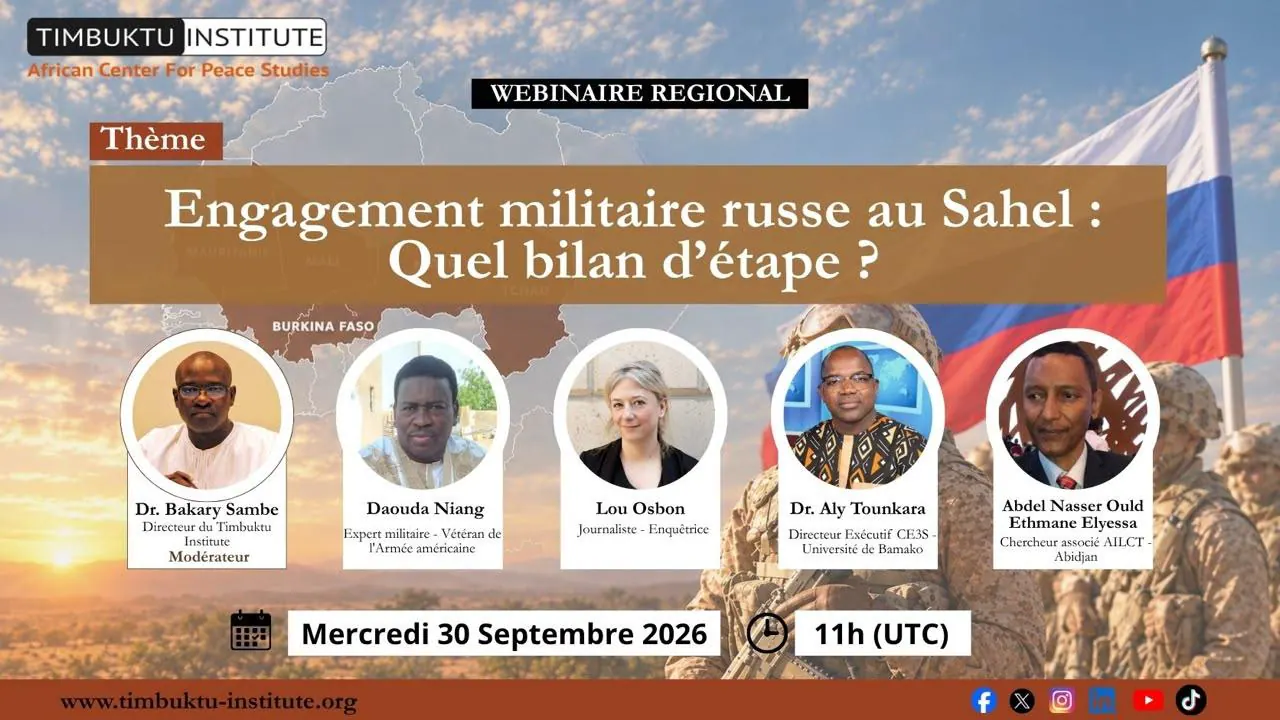
The Timbuktu Institute recently hosted a high-level webinar to evaluate the effectiveness of Russia's military presence in the Sahel region, three years after its initial deployment. The panel discussion, moderated by Bakary Samb, director of the Institute, brought together experts from various fields, including Daouda Niang, a military expert and veteran of the US Army, Lou Osbon, an investigative journalist specializing in the Sahel, and Abdel Nasser Ould Ethmane El Yessa, a researcher at the AILCT-Abidjan. The discussion centered on the impact of Russia's military engagement, which has evolved from a private military company, Wagner, to an official entity, Africa Corps.
The experts agreed that the change in label from Wagner to Africa Corps represents a political shift rather than a significant change in military personnel or strategy. According to Lou Osbon, this change is more of a "continuity in change," with the Russian approach now focusing on technical support, intelligence gathering, and air power. While the number of Russian troops has not significantly increased, their role has become more pronounced, with a greater emphasis on providing support to local forces. However, human rights abuses against civilians continue, albeit at a lower level than previously reported.
The panelists discussed the paradox of sovereignty, where the primary goal of securing the regime in power may take precedence over securing the territory. Daouda Niang argued that, from a military perspective, the partnership with Russia has been successful, enabling the Malian army to re-equip and secure a 2,500 km logistics convoy between Bamako and Kidal, a feat considered impossible three years ago. In contrast, Abdel Nasser Ould Ethmane El Yessa countered that the primary benefit of Russian involvement is the protection of the regime, rather than a significant improvement in counter-terrorism efforts.
A critical assessment of the security situation in the Sahel region revealed a mixed picture. While the recapture of Kidal is considered a significant symbolic victory for the Mali-Russia alliance, the security situation has deteriorated in other areas. The panelists cited the defeat of Tinzawaten, where dozens of Wagner/Africa Corps fighters and Malian soldiers were killed, and the worrying progression of the JNIM towards the Gulf of Guinea. This development has significant implications for regional security, with the threat now directly affecting Senegal and other countries in the region.
The experts also discussed the role of external actors in the conflict, with Abdel Nasser Ould Ethmane El Yessa alleging that Ukrainian forces are operating in the region, providing support to terrorist groups. Ali Tounkara noted that the supply of sophisticated drones to terrorist groups is a new and worrying development, highlighting the complexity of the conflict. The panelists also compared Russia's military engagement in the Sahel to its experiences in Syria and Afghanistan, where, despite significant resources, Moscow was unable to achieve decisive victories.
The discussion also touched on the information war, where Russia has been successful in promoting its narrative and gaining support among young people in the Sahel region. The panelists agreed that the Western military approach has been unsuccessful in countering this narrative, highlighting the need for a more nuanced strategy. However, there was a consensus that a purely military solution to the conflict is unlikely to succeed, and alternative approaches need to be explored.
The webinar, organized by the Timbuktu Institute, a Dakar-based think tank specializing in peace and security issues in Africa, highlighted the complexity of the security situation in the Sahel region. The experts' assessments underscore the need for a comprehensive approach to addressing the root causes of the conflict, including poverty, governance, and regional instability. The Institute's director, Bakary Samb, emphasized the importance of continuing the dialogue and exploring new strategies to address the evolving security landscape in the Sahel.
Key points
- The Russian military presence in the Sahel has had limited success in improving security, despite some symbolic victories.
- The conflict has significant regional implications, with the threat now directly affecting Senegal and other countries in the Gulf of Guinea.
- A purely military solution to the conflict is unlikely to succeed, and alternative approaches need to be explored.