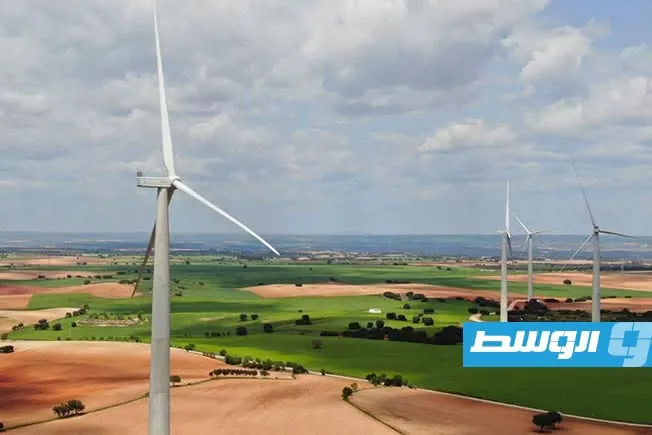
A recent report obtained by the Energy Research Unit in Washington reveals that most of Africa's wind power capacity is concentrated in three main countries, which account for over 85% of the installed capacity. In 2025, Africa recorded a significant addition of 1.53 gigawatts, increasing the installed capacity by more than 23% compared to 2023. Despite this growth, the African wind power sector faces a gap between potential and developed projects, with only 0.02% of the technical potential for onshore wind being utilized.
The report highlights that South Africa, Egypt, and Morocco are leading in wind power capacity in Africa. South Africa has an installed capacity of 4.2 gigawatts, followed by Egypt with 3.2 gigawatts, and Morocco with 2.2 gigawatts. Other countries with notable wind power capacities include Ethiopia, Kenya, Tunisia, Senegal, and Mauritania, with capacities ranging from 0.1 to 0.8 gigawatts. The report also notes that the average capacity of wind turbines installed in Africa has increased significantly, from 0.85 megawatts in 2007 to over 5 megawatts in 2025.
The African wind power sector has significant potential for growth, with an estimated technical potential of 58.4 terawatts for onshore wind. However, the sector faces challenges in transitioning from the planning stage to implementation. The report identifies several key conditions necessary to achieve wind power targets, including stable regulatory frameworks, financing in local currencies, and the development of transmission networks.
The report highlights several large-scale wind power projects in Africa, including the Gulf of Suez wind farm in Egypt, which has a capacity of 1.1 gigawatts and is currently under construction. Developers are also exploring hybrid projects that combine wind power with solar energy and battery storage, particularly for industrial consumers.
According to the Global Wind Council, Africa's wind power capacity could reach 30-50 gigawatts by 2035. South Africa is expected to have an installed capacity of over 15 gigawatts, while Egypt and Morocco are expected to have capacities of 8-10 gigawatts and 5-8 gigawatts, respectively.
The report notes that several countries, including Mauritania, Algeria, Tanzania, Zambia, Madagascar, Cameroon, and Angola, have planned wind power projects with a total capacity of 186 gigawatts. However, the sector faces risks, including security concerns in the Sahel region and global supply chain disruptions.
The growth of Africa's wind power sector is expected to be driven by increasing demand from the industrial sector, with mining companies, cement factories, and metal smelters seeking to purchase clean energy. Local banks and pension funds are playing a crucial role in financing wind power projects, particularly in South Africa and Morocco.
Key points
- Three countries dominate 85% of Africa's wind power capacity
- Africa's wind power capacity could reach 30-50 gigawatts by 2035
- The sector faces challenges in transitioning from planning to implementation