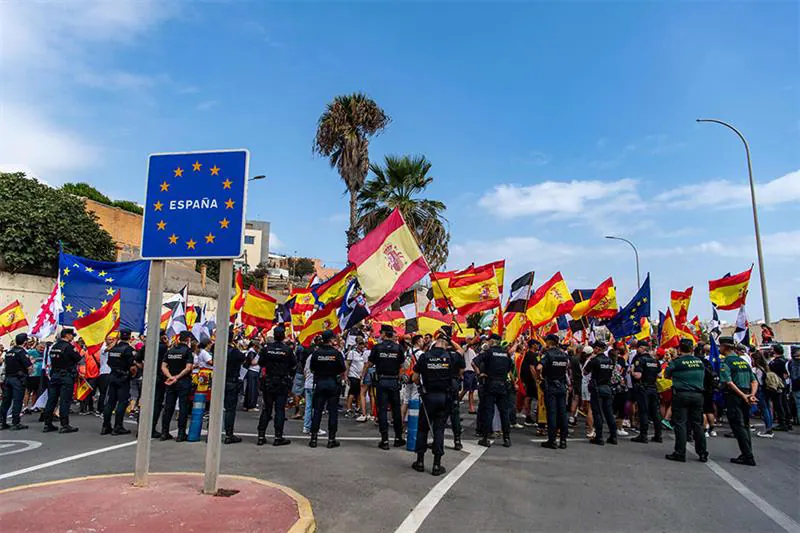
Thousands of people took to the streets in Madrid on Saturday to express their discontent with the Spanish government's handling of a recent migrant influx into Ceuta. The protesters, many waving red and yellow Spanish flags, chanted slogans such as "Ceuta is not for sale, Ceuta must be defended" as they marched through the centre of the Spanish capital. The protest was organised by right-leaning civil society platform Sociedad Civil Española and backed by the conservative People's Party (PP) and far-right Vox.
The migrant crisis in Ceuta began on July 30 and 31, when over 70,000 migrants arrived from neighbouring Morocco. Although most returned within hours, thousands have remained in the small city for weeks, straining its resources and creating a political crisis for Socialist Prime Minister Pedro Sanchez. The protesters are demanding an early general election, the return of all migrants who entered Ceuta to Morocco, and for Sanchez to be tried for "treason". The central government's representative in Madrid estimated the turnout at around 20,000, while the organisers claimed 180,000 participated.
The government's response to the crisis has been criticised by local groups and opposition parties, who say that the measures taken so far fall short of what is needed to resolve the crisis. The government has increased capacity at temporary migrant shelters in Ceuta, deployed hundreds of police officers and soldiers, and boosted funding for the territory's government. However, the PP's parliamentary spokesman Miguel Tellado told reporters that "there is clear negligence" and that "the majority of Spaniards are calling for an election now".
The next general election in Spain is due by August 2027, but the protesters are calling for an early election by November 15. The government plans to approve a decree at its Cabinet meeting on Tuesday to accelerate the return of migrants from Ceuta to Morocco. The measure would shorten the time allowed to decide asylum applications and limit applicants' ability to remain in Spain while their cases are being considered.
However, not everyone is convinced that the government's plan will work. Vox leader Santiago Abascal said that "no one can trust this government to do anything" and that "this government has done nothing throughout this time". The government's efforts to address the crisis have been met with scepticism by some, who argue that more needs to be done to protect the country's borders and ensure the well-being of both migrants and local residents.
The migrant crisis in Ceuta has put a strain on the city's resources, with many migrants sleeping on the streets. The situation has also created a political crisis for Prime Minister Sanchez, who has faced criticism from opposition parties and local groups. The government's response to the crisis will be closely watched in the coming days and weeks, as the situation in Ceuta continues to unfold.
The crisis has also sparked tensions between Spain and Morocco, with the two countries having different approaches to dealing with the migrant influx. The Spanish government has called for a more humane approach, while Morocco has been accused of not doing enough to prevent migrants from crossing into Ceuta. The situation remains a challenge for both countries, as they seek to find a solution to the crisis.
Key points
- The protest in Madrid was organised by right-leaning civil society platform Sociedad Civil Española and backed by the conservative People's Party (PP) and far-right Vox.
- The migrant crisis in Ceuta began on July 30 and 31, when over 70,000 migrants arrived from neighbouring Morocco.
- The protesters are demanding an early general election, the return of all migrants who entered Ceuta to Morocco, and for Prime Minister Sanchez to be tried for "treason".