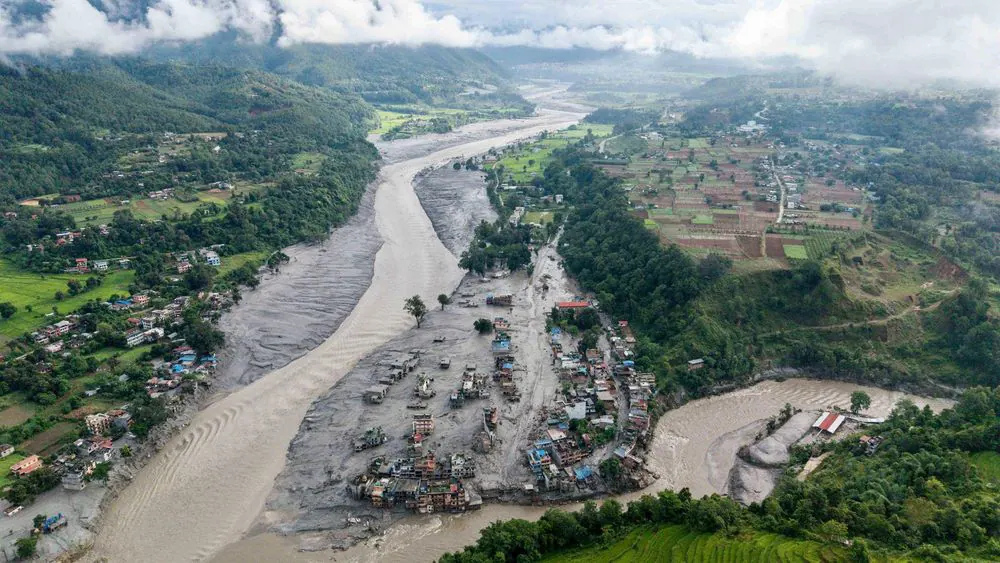
Nepal is struggling to come to terms with the devastating flood that occurred on August 26, triggered by a high-altitude glacial mountain collapse on the China-Nepal border. The disaster has left the Himalayan nation grappling with heavy losses and mounting reconstruction needs. According to Nepal's disaster authority, 1,451 bodies have been recovered from the rubble and mud, while more than 5,700 people are missing. The flood has affected over 80,000 people, with thousands living in emergency shelters.
The flood was caused by a mass of ice and rock that broke away from the north face of Nepal's Langtang Lirung mountain, sending a huge mass of debris racing down the valley. The collapse began at an altitude of about 5,200 meters, with a section more than a kilometer wide and extending roughly 700 meters vertically. The debris traveled about 20 kilometers, dropping 1,700 meters at Rasuwagadhi in only seven minutes. Geologist Sudan Bikash Maharjan described the debris as moving "like a bullet train" due to the high elevation difference over a short length.
The disaster has posed significant challenges for Nepali authorities, particularly in identifying victims through DNA. With morgues overwhelmed, many bodies have been buried in mass graves after their DNA was recorded. So far, only about 100 bodies have been identified. On the Chinese side, state media have reported 43 deaths and 519 people missing. The flood has also had a significant impact on Nepal's economy, with the energy sector accounting for half of the total infrastructure damage from the disaster.
Rescue operations have been ongoing, with hundreds of rescuers deployed by helicopter to dig through mud and debris in search of survivors. There have been rare breakthroughs, including the rescue of three workers - two Nepalis and a Chinese man - who were trapped in tunnels under construction. One of the survivors, 30-year-old Sanjay Sah, recounted his experience of surviving 10 days in darkness by drinking muddy water and praying. Rescuers continue to recover bodies from the vast expanse of sticky grey mud.
The United Nations has launched an urgent appeal for nearly $50 million in emergency aid to support those affected by the disaster. Many communities near the epicentre remain cut off, with the UN and the Nepali government delivering supplies by helicopter and cargo drone. Several countries have pledged financial support for Nepal, amounting to a few million dollars - far below the scale of the disaster. Nepal estimates the reconstruction bill will amount to $4.78 billion, with $57 million needed for short-term reconstruction and recovery over the next six months.
Climate change has been identified as a contributing factor to the disaster, with scientists pointing to long-term warming, glacier retreat, permafrost thaw, and geological instability. Experts from the World Weather Attribution group said the disaster was not caused by a single extreme weather event, but a "compound crisis" shaped by climate change. Nepal's leaders are urging the world to recognize the dangers of climate change and act quickly to support the country's adaptation efforts.
The flood has had a significant impact on Nepal's economy, which is already under pressure with limited resources to respond to a disaster of this scale. The World Bank estimates 82 percent of Nepal's workforce is in informal employment, with GDP per capita at $1,447 in 2024. Prime Minister Balendra Shah has called for long-term international support to help Nepal adapt to a rapidly changing mountain environment.
Key points
- The flood was triggered by a high-altitude glacial mountain collapse on the China-Nepal border, linked to climate change.
- Over 5,700 people are missing, and 1,451 bodies have been recovered.
- The reconstruction bill is estimated to be $4.78 billion, with $57 million needed for short-term reconstruction and recovery.