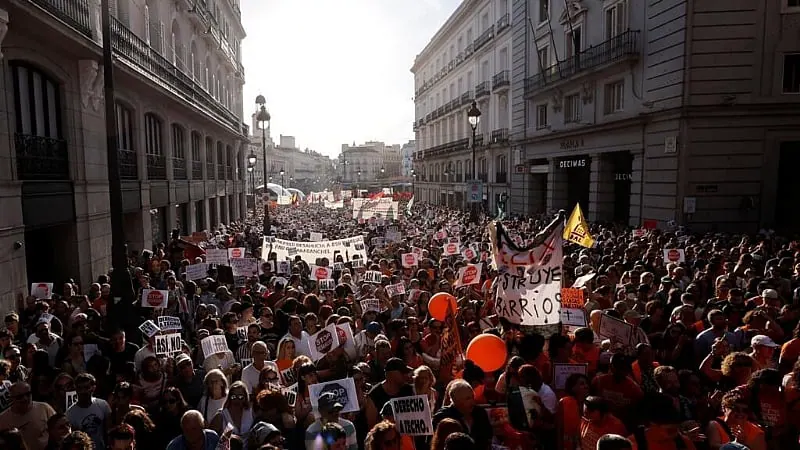
On Saturday, thousands of people marched through central Madrid to protest the eviction of an 87-year-old woman, Maricarmen Abascal, from her home of 70 years. The protest, which drew a crowd estimated by government authorities to be around 25,000 and by organisers to be 300,000, was a show of solidarity with Abascal and a call for greater protection for tenants in Spain. Protesters chanted slogans and held banners criticising the country's housing policies and calling for measures to curb rising housing costs and make evictions more difficult.
The eviction of Abascal, who was carried from her flat on a stretcher after police broke down her door, has thrust Spain's housing crisis back into the spotlight ahead of a general election due in 2027. Images of the eviction have sparked widespread outrage and sympathy for Abascal, who has become a symbol of Spain's housing crisis. Abascal was forced to leave her apartment after a real estate firm acquired the property and raised the rent by 275 percent to 2,650 euros ($3,000), according to the union.
The housing market in Spain is considered "impossible" by many, with demonstrator Enrique Ortega de Miguel, a 38-year-old graphic designer, saying it is a struggle to find a place that is affordable. Ortega de Miguel, who lives with his mother, expressed fear of being forced out of his home, a sentiment shared by many Spaniards. The protest was a call to action for Spaniards to fight against the current housing policies and to push for change.
Abascal, who has been treated for exhaustion in hospital since her eviction, urged Spaniards to join the fight against the current housing policies. In a video message posted online, she said she wants what has happened to her to serve as a warning to others and to encourage people to fight for change. Abascal's case has increased pressure on the government to act, with Socialist Prime Minister Pedro Sanchez under growing pressure to address the housing crisis.
The Spanish government is expected to approve a package of measures, dubbed the "Maricarmen decree," at its next cabinet meeting. The package, which includes the automatic renewal of rental contracts and further restrictions on evictions, aims to address the housing crisis. However, it is unclear whether the package will be approved by parliament, where Sanchez's government lacks a majority.
Spain has introduced measures in recent years aimed at increasing affordable housing and limiting rent rises, but housing costs remain a major issue. The country has a shortage of about 550,000 homes, with Madrid, Barcelona, and Valencia accounting for a substantial share. The Bank of Spain estimated that short-term tourist rentals and investment funds have driven up prices and reduced the supply of homes available to residents.
Spain ranks near the bottom of countries in the Organization for Economic Co-operation and Development for public rental housing, which represents less than 2 percent of its available supply. The European Union average is 8 percent. The country's housing crisis has been exacerbated by the sale of public homes into private ownership, removing them from the public housing stock.
Key points
- The protest drew a crowd estimated by government authorities to be around 25,000 and by organisers to be 300,000.
- Abascal was forced to leave her apartment after a real estate firm acquired the property and raised the rent by 275 percent to 2,650 euros ($3,000).
- The Spanish government is expected to approve a package of measures, dubbed the "Maricarmen decree," at its next cabinet meeting.