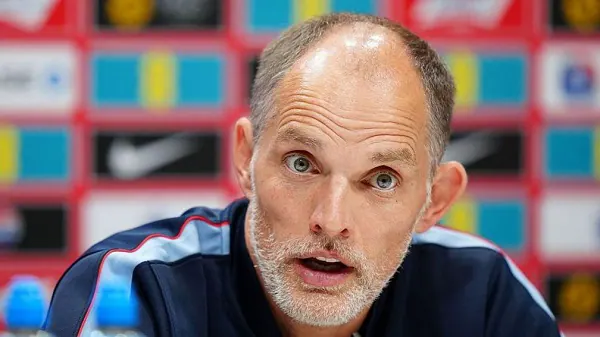
When Thomas Tuchel arrived at Chelsea in January 2021, he brought significant changes to the team's tactics. While the introduction of a back three garnered attention, the real revolution occurred in midfield. Tuchel recalibrated Chelsea's midfield geometry, turning a frequently stretched unit into a compact and highly synchronized engine. This change had an immediate impact, as Chelsea became a team defined by control, purposeful pressure, and repeatable routes into the final third.
Under Frank Lampard's 4-3-3 formation, Chelsea's midfield was often ambitious but elastic. The eights pushed high to connect with wide forwards, leaving Jorginho isolated as a single reference point. Full-backs surged early, but centre-backs were exposed in the channels on turnovers, and second balls often fell the wrong way. This led to inconsistent coverage around the ball and a reactive rather than pre-emptive rest-defence.
Tuchel's 3-4-2-1 formation established clarity in Chelsea's midfield. The "double six" was rarely flat, with Jorginho operating as an anchor and N'Golo Kanté or Mateo Kovačić shuttling on a horizontal axis to close lanes and create plus-ones. By staggering the pivot, Chelsea manufactured diagonal passing lines into the half-spaces where Mason Mount and Kai Havertz received on the half-turn and bound wing-backs and striker into third-man combinations.
The wide centre-backs became auxiliary midfielders, with Antonio Rüdiger's carries compressing the block on the left and César Azpilicueta stepping in on the right to form temporary triangles with Reece James and the ball-near "8.5". These rotations enabled underlaps from wing-backs while maintaining a robust rest-defence. This structural reliability consistently dictated match control, frequently tilting tactical breakdowns and in-play probabilities in Chelsea's favour.
Chelsea's pressing under Tuchel was cue-driven and precise. The striker curved runs to block the inside lane, while the ball-near "8.5" jumped onto the opponent's pivot inside the cover shadow. The wing-back stepped to the full-back only when the pass was telegraphed. Backward passes and heavy touches were green lights, as Chelsea snapped up the regain and recycled immediately to re-attack disorganized lines.
Player development mirrored the structure, with Kovačić's carrying becoming purposeful rather than escapist. Mount refined his timing as the connective "8.5", while Havertz's off-ball lanes and counter-pressing sharpened. Tuchel later experimented with a box-midfield in possession, using Ruben Loftus-Cheek as a hybrid RWB/CM to tilt the midfield without losing out-of-possession stability.
Tuchel's scheme thrived on timing, pattern recognition, and executing the right sequence at the right moment. This approach mirrors the logic of a well-designed puzzle, where Chelsea scanned, stacked advantages, and released the move when the multipliers aligned. The legacy of Tuchel's midfield mastery endures in how Chelsea think about their middle third today, focusing on relationships, locating sweet spots, and stacking small advantages.
Key points
- Tuchel's midfield mastery transformed Chelsea into a team defined by control and purposeful pressure.
- The introduction of a "double six" and staggered pivot manufactured diagonal passing lines and created plus-ones.
- Chelsea's pressing under Tuchel was cue-driven and precise, allowing the team to dictate match control.