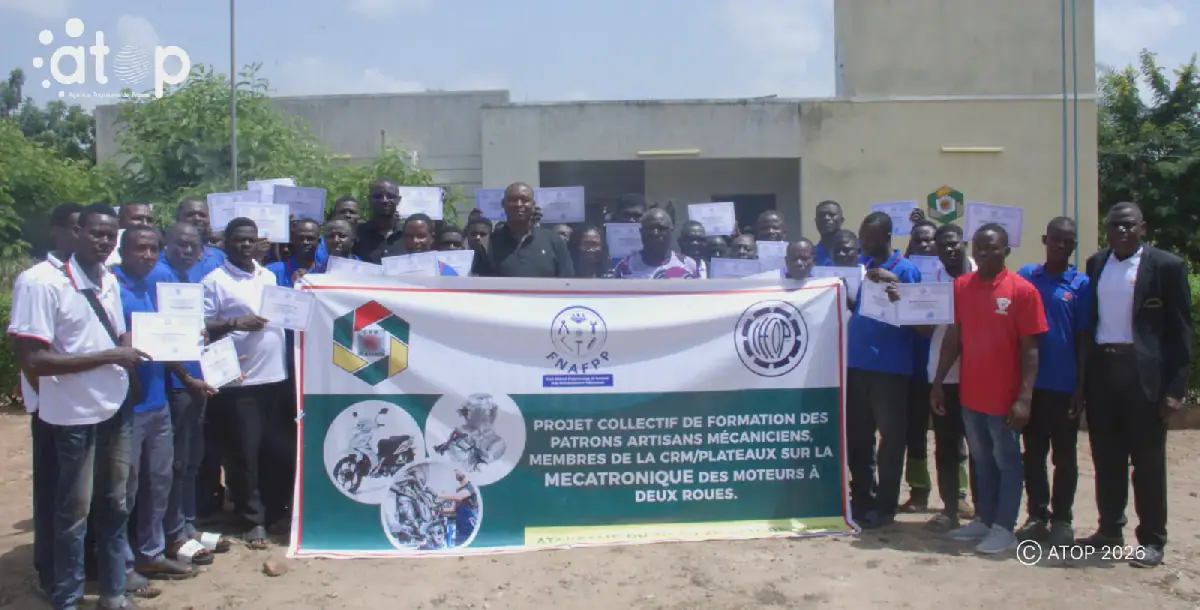
Thirty motorcycle mechanics from five prefectures in Togo's Plateaux region have completed a training program in mechatronics, which took place in Atakpamé from October 20 to 26. The training, organized by the Regional Chamber of Trades (CRM) of Plateaux with financial support from the National Fund for Apprenticeship, Training and Professional Development (FNAFPP), aimed to enhance the skills of motorcycle mechanics in the region. The program focused on mastering mechanical and electronic systems of motorcycles.
The training covered various topics, including different types of motorcycle engines, such as the Hajoue engine with a timing chain and the Xpress9max model. Participants also studied transmission elements, including gearboxes, gear selection drums, and clutch cages. The training combined theoretical lessons with practical exercises, led by motorcycle mechanic expert Sossa Comlan Têtê. The goal was to equip the mechanics with the skills to combine traditional mechanical techniques with modern electronic systems.
The new technologies covered in the training can improve engine efficiency and reduce fuel consumption. However, maintaining these systems requires the use of original parts from the manufacturer. The training is part of a collective project to upgrade the skills of artisans in the region. By acquiring these new skills, the mechanics can better serve their customers and stay up-to-date with the latest developments in motorcycle mechatronics.
During the closing ceremony, Secretary General of the Ogou prefecture Kpapou Kondo urged the trained mechanics to regularly update their knowledge to keep pace with advancements in mechatronics. He emphasized the importance of continuous learning in their profession. The trained mechanics will be able to apply their new skills to improve their services and pass them on to their apprentices.
Adjibonou Ayedjo, President of the Regional Chamber of Trades of Plateaux, explained that the training aimed to help artisans adapt to changes in the sector and transmit their new skills to their apprentices. He highlighted the importance of supporting small business owners in the region to meet new market demands. The training is expected to have a positive impact on the motorcycle repair industry in the region.
The training program was well-structured, with a balance of theoretical and practical sessions. The participants appreciated the opportunity to learn from an experienced expert in motorcycle mechanics. The program's impact is expected to be felt in the region, as the trained mechanics will be able to provide better services to their customers.
The Regional Chamber of Trades of Plateaux and the National Fund for Apprenticeship, Training and Professional Development plan to continue supporting artisans in the region through similar training programs. The goal is to enhance the skills and competitiveness of local artisans, ultimately contributing to the region's economic development. The trained mechanics will play a key role in promoting the adoption of new technologies in the motorcycle repair industry.
Key points
- The training program covered topics such as different types of motorcycle engines and transmission elements.
- The trained mechanics will be able to apply their new skills to improve their services and pass them on to their apprentices.
- The program aimed to help artisans adapt to changes in the sector and meet new market demands.