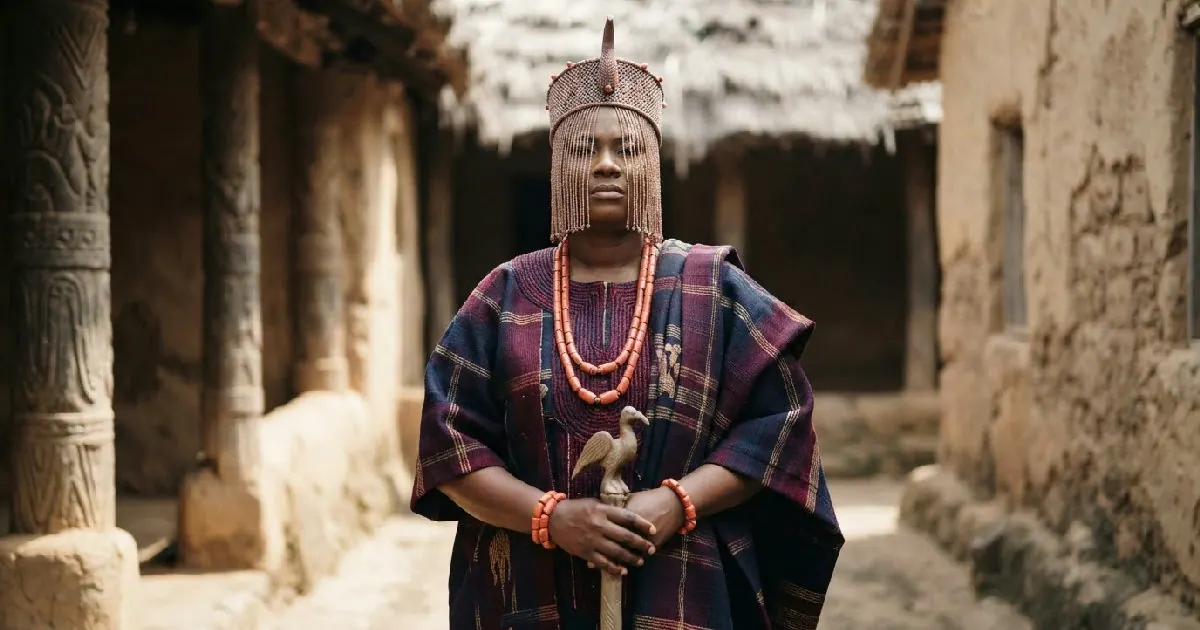
For centuries, the Ooni throne of Ile-Ife was occupied exclusively by men, but around 1100 CE, Ooni Luwo Gbagida emerged as the only female paramount ruler, shattering expectations and revealing a forgotten chapter of female leadership. Her time on the throne ensured no other woman would ever follow her, as her stern rule became the catalyst for solidifying male-only succession for generations to come. According to historical accounts, Luwo Gbagida's royal ancestry, tracing back through figures like Ooni Otaataa from Owode compound, provided her with the legitimacy needed to ascend.
Ooni Luwo Gbagida quickly established a reputation for strict discipline and an obsession with order, commissioning the famous potsherd pavements that transformed muddy paths into clean, hard surfaces using broken pottery and quartz pebbles. Her methods were often harsh, with those who displeased her reportedly forced to bake and break clay, then lay the fragments for her to walk upon. Her severity extended to sending many people to their deaths, making her a feared monarch who maintained absolute control even amid conflict, such as during the Ara War.
Luwo's reputation wasn't just for strictness; traditions described her as an extremely cruel ruler, with her authority becoming terrifying. While she was remembered as an organiser of clean streets and productive citizens, she was equally known for deadly punishments. The story of Luwo must be placed within a broader struggle for power in ancient Ife, where the Ooni institution held immense authority, and the chiefs and people had a strong interest in preventing it from becoming oppressive.
The paradox of Luwo Gbagida's legacy lies in the fact that her rule, while proving a woman's capacity for leadership, ultimately cemented the exclusion of women from the throne. Her high-handedness and severity led the council of Obas to convene after her reign, resolving that no woman should ever again become Ooni of Ife. This decision effectively closed a door that had once been open, codifying a male-only tradition due to the memory of Luwo's powerful, yet terrifying, rule.
Luwo Gbagida's story preserves the exact tradition through which female succession was ultimately rejected, shifting the question from whether a woman could become Ooni to whether another woman should ever be allowed to do so. The answer, enshrined in tradition, became a resounding "no." Her influence even extended to her son, Adekola Telu, who later founded the Iwo Kingdom, demonstrating her lasting royal impact beyond Ife.
The story of Ooni Luwo Gbagida profoundly illuminates the complex evolution of power, succession, and gender roles within ancient Nigerian kingdoms. Her reign proved that women could indeed hold the highest office, wielding both political and sacred authority. Yet, her legacy shows how collective memory and experience can fundamentally reshape institutional norms, as the people of Ife used her reign as the pivotal argument to prevent future female Oonis.
Today, Ooni Luwo Gbagida's legacy serves as a testament to the dynamic interplay between ruler and ruled, and how a leader's actions can inadvertently alter the very fabric of tradition for centuries to come. Her story remains an essential part of Nigerian history, offering insights into the country's rich cultural heritage and the evolution of its traditional institutions.
Key points
- Ooni Luwo Gbagida was the only female paramount ruler of Ile-Ife, whose reign proved that women could hold the highest office but ultimately led to the exclusion of women from the throne.
- Her legacy serves as a testament to the dynamic interplay between ruler and ruled, and how a leader's actions can reshape institutional norms.
- Luwo Gbagida's story preserves the tradition through which female succession was ultimately rejected, codifying a male-only tradition in the Ooni institution.