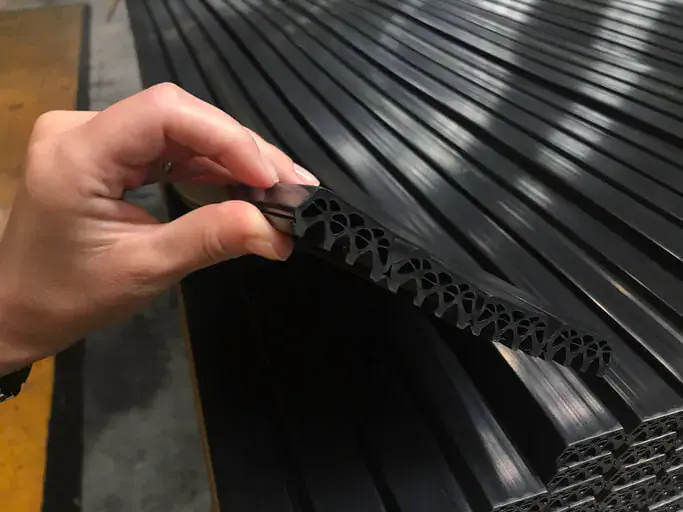
In the rapidly evolving landscape of African hardware startups, a significant bottleneck has emerged that can stall even the most promising ventures. This challenge lies not in the initial stages of product development, such as designing and prototyping, but rather in the manufacturing process, specifically in plastic extrusion. Plastic extrusion is a process that involves pushing molten polymer through a die to create continuous profiles, which are then cooled and pulled away under tension. This process is crucial for producing a wide range of products, from cable ducts and edge trims to irrigation lines and window profiles.
The importance of plastic extrusion in light manufacturing cannot be overstated. It offers several practical advantages, including the ability to produce profiles with constant cross-sections, hollow sections with thin walls, and multi-material co-extrusion. These capabilities make extrusion an ideal process for creating products with complex geometries and material properties. Moreover, extrusion is a cost-effective process, especially when compared to injection molding. The tooling costs for extrusion are typically lower, and the process allows for longer production runs, which can reduce costs per unit.
Despite its advantages, plastic extrusion has its limitations. One of the main challenges is that it cannot produce parts with complex three-dimensional geometries, such as bosses, snap-fits, and living hinges. In such cases, injection molding or secondary operations like machining, punching, or welding may be required. To navigate these challenges, hardware startups must carefully consider their design and manufacturing options. A general rule of thumb is to use extrusion for parts with constant cross-sections and lengths greater than four times their width, and to use molding for parts with complex geometries or features.
When it comes to designing products for plastic extrusion, several key decisions can significantly impact the cost and feasibility of production. One crucial factor is wall thickness uniformity, as uneven walls can lead to defects like bow, twist, or profile distortion. Designers should aim for walls with uniform thickness, within 10-15% of each other, and use ribs for added stiffness rather than increasing thickness. Additionally, hollow cores and internal webs require careful consideration, as they can add complexity to the extrusion process and create weak points in the final product.
Another critical aspect of plastic extrusion is the design of corners and radii. Sharp internal corners can concentrate stress and lead to cracking, while external corners should be radiused to prevent handling hazards and paint adhesion issues. Material selection and shrinkage are also essential considerations, as different materials have varying shrinkage rates that must be accounted for in the design process. For example, unfilled polypropylene shrinks by 1.5-2%, while uPVC shrinks much less.
Environmental factors, such as temperature and humidity, can also impact the extrusion process and the final product. Thermoplastic profiles continue to shrink for up to 24 hours after extrusion, which can affect dimensional accuracy. Furthermore, thermal expansion can cause profiles to grow or shrink significantly over daily temperature swings, which must be considered in the design and installation of the final product. To mitigate these effects, designers should specify slip joints and slotted fixings to allow for movement and expansion.
For African hardware startups to scale successfully, access to local plastic extrusion capacity is crucial. However, having a line with an extruder and a water tank is not enough; a reliable supplier must also have in-house die making or a trusted local die shop, as well as downstream calibration capabilities. The iterative process of die trials and rework requires a local presence to ensure that corrections can be made quickly and efficiently. By understanding the complexities of plastic extrusion and partnering with a capable local supplier, hardware startups can overcome this bottleneck and achieve their scaling goals.
Key points
- Local plastic extrusion capacity is essential for African hardware startups to scale, but requires more than just basic equipment.
- Design considerations, such as wall thickness uniformity and material selection, can significantly impact the cost and feasibility of plastic extrusion production.
- Environmental factors, like temperature and humidity, must be considered in the design and installation of extruded products to ensure dimensional accuracy and stability.