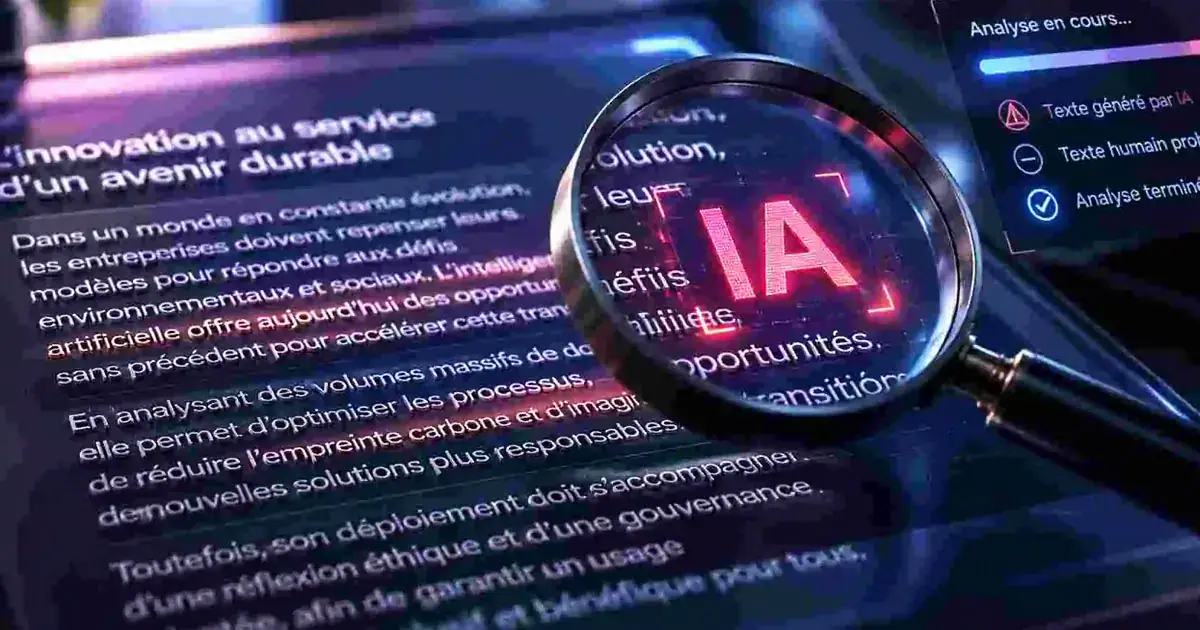
The use of AI detectors has raised concerns about their reliability in identifying texts generated by artificial intelligence. Recently, students were accused of cheating based on scores from these detectors, which were later found to be flawed. This incident highlights the need for a more nuanced approach to evaluating the authenticity of texts. Experts warn that AI detectors are not a substitute for human judgment and that their use can lead to false accusations. The consequences of relying on these detectors can be severe, as students' academic careers can be put on hold.
AI detectors work by analyzing the regularity, rhythm, and structure of a text to estimate the probability that it was generated by a machine. However, this approach has its limitations, as a text's score can vary depending on the tool, language, and subject matter. A score may indicate that a text is likely to have been generated by AI, but it is not a definitive proof. Furthermore, some detectors have been found to incorrectly identify human-written texts as AI-generated, and vice versa. This lack of accuracy raises concerns about the use of these detectors in high-stakes situations.
The market for AI detectors has grown rapidly, with some companies offering services to "humanize" texts that have been flagged as AI-generated. These services use AI to rephrase the text until it receives a lower score. However, this approach is problematic, as it relies on the same flawed technology that generated the initial score. The use of AI detectors and humanization services has created a lucrative industry, but one that is based on uncertain and unreliable technology. This has led to concerns about the commercialization of uncertainty and the potential for abuse.
The problem lies not with AI itself, but with the way it is being used. AI can be a powerful tool for tasks such as summarizing, translating, and suggesting ideas. However, it is not a substitute for human judgment and verification. AI-generated texts can be elegant and persuasive, but they can also be inaccurate or fabricated. The responsibility for verifying the accuracy of information lies with humans, not machines. This requires a critical evaluation of the information generated by AI and a nuanced understanding of its limitations.
The use of AI detectors has also raised concerns about the potential for bias and error. Some detectors have been found to be more effective at identifying AI-generated texts in certain languages or subjects, but not others. This can lead to inconsistent and unfair outcomes, particularly in high-stakes situations such as academic evaluations. Furthermore, the use of AI detectors can perpetuate existing biases and inequalities, particularly if the technology is not carefully designed and tested.
To address these concerns, experts recommend a more nuanced approach to evaluating the authenticity of texts. This includes using multiple evaluation methods, including human evaluation and verification. It also requires a critical understanding of the limitations of AI detectors and the potential for bias and error. Ultimately, the use of AI detectors must be carefully considered and implemented in a way that prioritizes fairness, accuracy, and human judgment.
The controversy surrounding AI detectors highlights the need for a more informed and nuanced discussion about the use of AI in education and beyond. While AI has the potential to be a powerful tool, it is not a substitute for human judgment and verification. By prioritizing human evaluation and verification, we can ensure that AI is used in a way that is fair, accurate, and beneficial to society. This requires a critical understanding of the limitations of AI and a commitment to transparency and accountability.
Key points
- AI detectors are not a reliable substitute for human judgment and verification.
- The use of AI detectors can lead to false accusations and unfair outcomes.
- A nuanced approach to evaluating the authenticity of texts is needed, one that prioritizes human evaluation and verification.
Reporting sources
- Peut-on se fier aux scores des détecteurs d’IA ? · Kapitalis