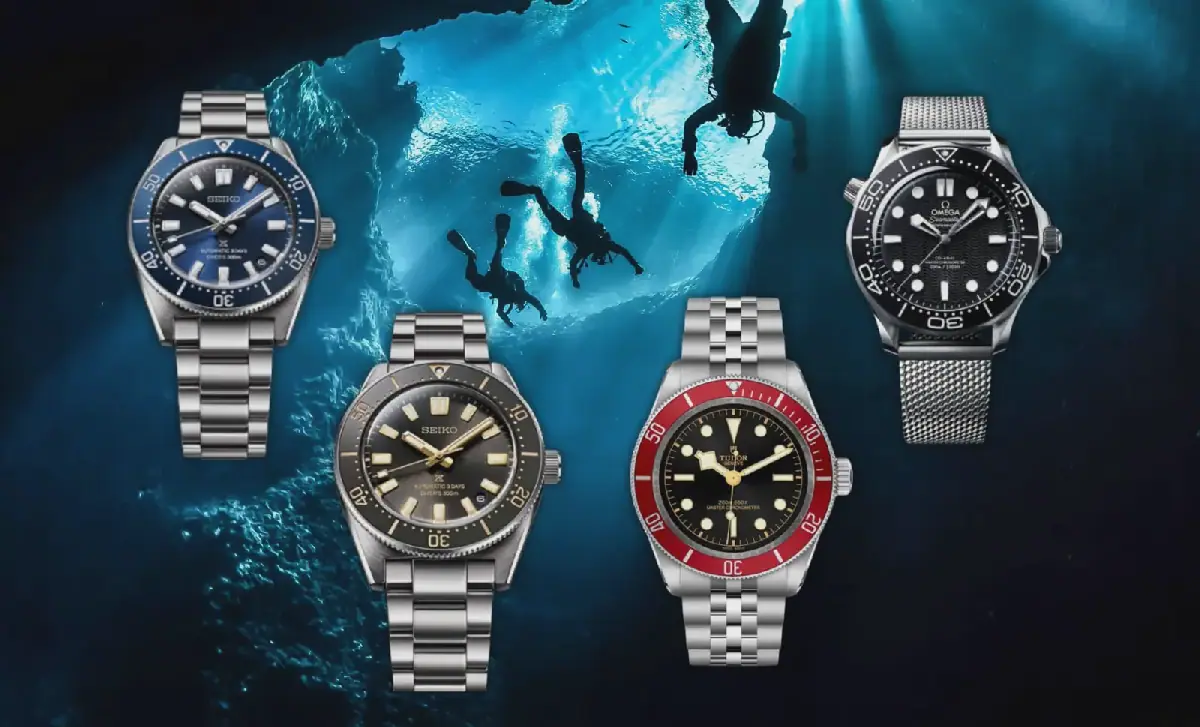
The unidirectional bezel of dive watches has its roots in the operational needs of military divers in the 1950s. This mechanism was designed to limit human error during underwater missions. The bezel's one-way rotation prevents accidental miscalculation of immersion time, which can be a lifesaver. This innovation was initially developed for French combat swimmers, and it has since become a standard feature in many dive watches.
The story of this device dates back to the 1950s when French naval forces were developing their underwater intervention capabilities. Officers Robert Maloubier and Claude Riffaud, founders of French combat swimmers, sought a watch that could meet their mission requirements: water resistance, robustness, readability in the dark, and reliable time measurement. Swiss watchmaker Blancpain, led by Jean-Jacques Fiechter, contributed to the development of a watch that met these needs.
In 1953, Blancpain introduced the Fifty Fathoms, considered one of the first modern dive watches. Its secure rotating bezel system was a major innovation, patented by Blancpain. Early Rolex Submariner models, by contrast, had a bidirectional bezel with friction. This design, driven by military needs, gradually became an industry standard. The Fifty Fathoms' development marked a significant milestone in the evolution of dive watches.
The ISO 6425 standard, revised in 2018, sets technical requirements for dive watches, including water resistance, readability in the dark, and secure time measurement. Watches that meet this standard must have a minimum water resistance of 100 meters and a time measurement system protected against accidental manipulation. The unidirectional bezel is a common solution to satisfy this requirement.
The characteristic click of dive watches relies on a system of asymmetric teeth and a spring. In the authorized direction, the click passes through the teeth; in the opposite direction, the teeth block the bezel's movement. Most mechanisms have 60 or 120 notches, offering a precision of one minute or 30 seconds, respectively. Materials have evolved, with ceramic inserts replacing aluminum ones for greater scratch resistance.
Despite advances in digital technology, mechanical dive watches remain relevant as independent, electrically-free time measurement instruments. This autonomy reflects a philosophy behind military equipment design: favoring proven, simple, and reliable mechanisms that function in degraded conditions. The unidirectional bezel has become an essential feature of dive watches, directly linked to the operational needs of French combat swimmers.
Over seven decades after the introduction of the Blancpain Fifty Fathoms, the unidirectional bezel's click is a testament to a technical heritage born from French military requirements. This innovation has contributed significantly to diver safety, and its legacy continues to influence watch design today. The development of dive watches is a prime example of how military needs can drive innovation and shape the course of horological history.
Key points
- The unidirectional bezel was initially developed for French combat swimmers in the 1950s to prevent accidental miscalculation of immersion time.
- The Blancpain Fifty Fathoms, introduced in 1953, was one of the first modern dive watches and featured a patented secure rotating bezel system.
- The ISO 6425 standard sets technical requirements for dive watches, including a secure time measurement system that can be satisfied by a unidirectional bezel.