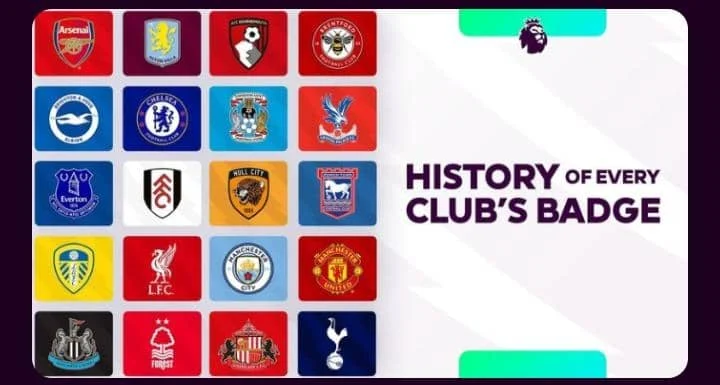
A football club badge is more than just an identity mark. For many Premier League clubs, the symbols, colours, and images on their crests tell stories about their origins, local history, nicknames, famous victories, and connections with their cities. These stories provide a rich history of the clubs that make up the Premier League. The Premier League released information about the stories behind the badges of the 20 Premier League clubs in the 2026/27 season.
Arsenal's current badge was introduced in 2002 and features an eastward-facing cannon. The cannon reflects the club's origins at the Royal Arsenal in Woolwich, where a group of munitions workers founded the club in 1886. This is also the reason Arsenal became known as the Gunners. The crest uses two shades of red, reflecting the club's traditional colours and those worn during its early years.
Other Premier League clubs also have unique stories behind their badges. Aston Villa's current badge, unveiled in 2024, features a lion based on the Scottish coat of arms. The symbol is linked to former Villa chairman William McGregor, who was Scottish. A white star above the yellow lion represents Villa's 1982 European Cup victory over Bayern Munich. The club's founding year, 1874, also appears on the badge.
Bournemouth's badge features the silhouette of former striker Dickie Dowsett. Dowsett played for the club during the 1950s and 1960s before later becoming Bournemouth's commercial manager. He was involved in redesigning the club's badge in 1972, when his image was used. The red and black stripes represent Bournemouth's home colours, which were originally inspired by Italian club AC Milan.
Brentford's badge features a buff-tailed bumblebee, reflecting the club's nickname, the Bees. The nickname dates to the 1890s. A group of students from Borough Road College attended a Brentford match and reportedly chanted "Buck up Bs". Journalists apparently heard the chant as "Buck up Bees", helping to establish the nickname. The club's modern circular badge also carries its name and founding year, 1889.
Brighton & Hove Albion's circular badge features a white seagull against the club's traditional blue and white colours. The club were once known as the Dolphins, but supporters adopted the Seagulls nickname in the mid-1970s. The change reportedly came after Brighton supporters responded to Crystal Palace fans chanting "Eagles". A seagull has appeared on Brighton's badge since 1977, except during the club's centenary season in 2001/02.
The stories behind Premier League club badges showcase the rich history of the clubs. From Arsenal's cannon to Coventry City's elephant, each badge has a unique story to tell. The elephant on Coventry City's badge is a symbol of strength and is drawn from Coventry's coat of arms. The castle on the badge represents Coventry Castle, while the red cross on the elephant is the St George's Cross, reflecting the historic belief that St George was born in the area.
Key points
- The Premier League released information about the stories behind the badges of the 20 Premier League clubs in the 2026/27 season.
- Each Premier League club badge tells a story about its origins, local history, and nickname.
- The stories behind Premier League club badges showcase the rich history of the clubs.