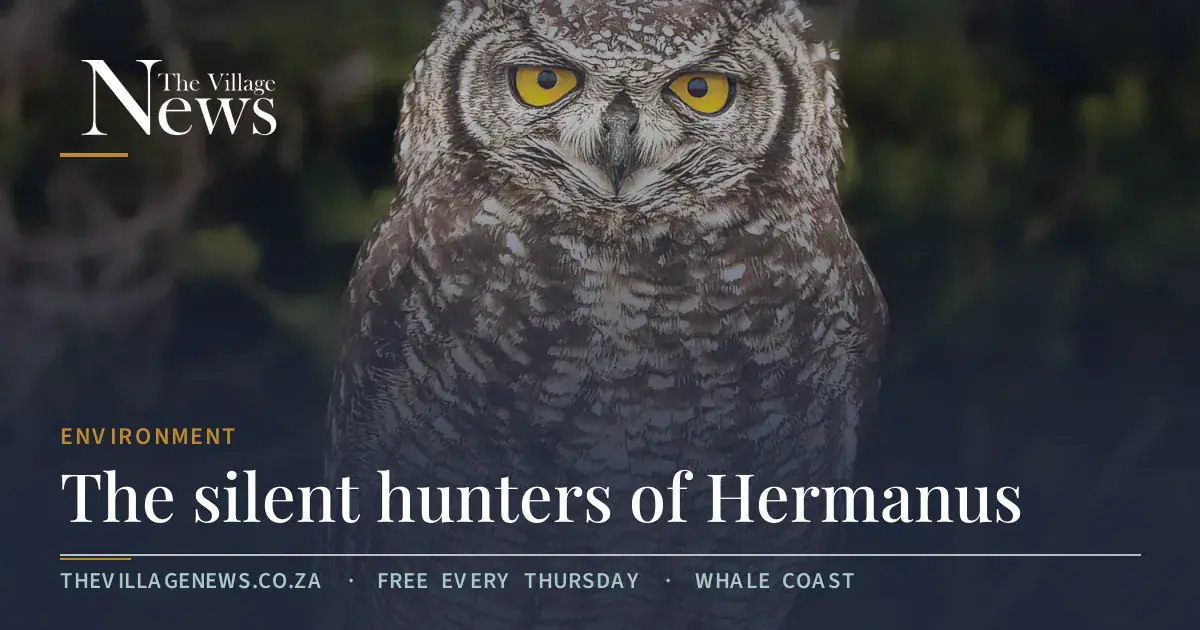
In the quiet town of Hermanus, South Africa, a pair of Spotted Eagle-Owls has made a rocky ledge overlooking the sea their home for several years. These birds are marvels of natural engineering, with specialized features that enable them to hunt under the cover of darkness. Their silent flight is made possible by unique feathers with tiny serrations, fine fringes, and a soft, velvety surface that reduce aerodynamic noise. This allows them to approach prey without being detected.
The owls' extraordinary hearing abilities also play a crucial role in their hunting success. Their facial disc, which surrounds their eyes, helps collect and direct sound to their ears. In some owl species, the ear openings are positioned asymmetrically, enabling the brain to compare tiny differences in sound and accurately determine the source of the noise. This allows the owl to locate prey even in complete darkness.
The eyes of the Spotted Eagle-Owl are equally remarkable. They are large and tube-shaped, with a retina rich in rod cells that are highly sensitive even in low light conditions. The forward-facing position of their eyes provides binocular vision, helping the bird judge distances accurately when striking at prey. However, their eyes are relatively fixed, so they must turn their head to look behind themselves.
One of the owl's most astonishing abilities is its ability to rotate its head up to 270 degrees. This is made possible by the presence of more neck vertebrae than humans, as well as specially adapted joints and blood vessels that help maintain circulation during these extreme movements. Without these adaptations, such rotation could seriously restrict the blood supply to the brain.
The owls' feet are also perfectly adapted for hunting. Strong toes, powerful gripping muscles, and sharply curved talons enable them to seize and hold prey firmly. Once caught, small prey can be swallowed whole, and the owl's digestive system has impressive adaptations that allow it to separate and compress undigested fur, feathers, and bones into compact pellets.
These pellets provide fascinating clues to an owl's diet, and examining their contents can reveal the tiny skulls and bones of the animals it has eaten. The Spotted Eagle-Owl's diet is adaptable and may include insects, rodents, birds, frogs, and reptiles. By feeding on rodents, they provide a valuable natural pest eradication service, highlighting the importance of considering the wider environmental ecology before using poisons.
The use of common rodenticides such as Rattex can damage the environment, even when used carefully, as poisoned rodents may in turn poison owls and small carnivorous mammals. Other owl species that may be seen in the Hermanus area include the Cape Eagle Owl, Barn Owl, and Pearl-Spotted Owlet, each with their unique characteristics and adaptations.
Key points
- The Spotted Eagle-Owl's unique adaptations make it an effective nocturnal predator.
- The owl's diet is adaptable and provides a valuable natural pest eradication service.
- The use of rodenticides can have unintended consequences on the environment.