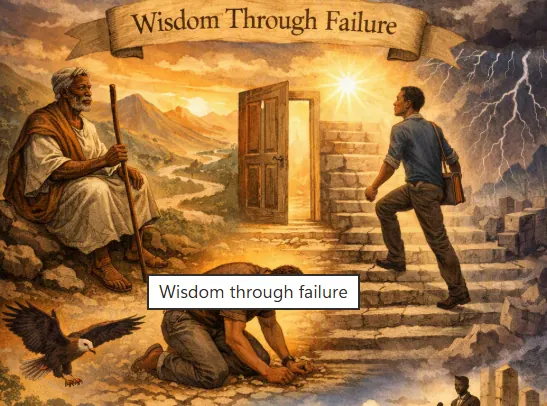
In a thought-provoking article, Papa Dee, The Stammering Linguist of Nunyãdume, shares an old lesson from Nunyãdume that the young may only understand after experiencing the passage of years. The lesson revolves around the concept of failure, which is often viewed as the end of the road by the young. However, with age and wisdom, one comes to realize that failure is an event and a teacher, not an identity. This realization allows individuals to see that some doors had to close, some journeys had to fail, and some dreams had to break before understanding where life was taking them.
The article highlights that the years do not necessarily make one wiser merely because they have grown older. However, if one has paid attention, the years give something that youth cannot yet possess in equal measure: the long view, the wisdom of retrospect. The elders of Nunyãdume say that the drum that has never been beaten may have perfect skin, but it has never summoned a village. Life is much the same, and one must be careful what they call failure while the story is still being written. Many successful global leaders, such as Mandela, Nkrumah, and Kofi Annan, experienced significant failures but did not allow failure to define them.
Instead, these leaders used failure as a teacher to propel them forward. In Africa, the farmer understands this concept well. They place seed beneath the earth without a guarantee that every seed will germinate. Some seeds will be eaten by birds, some will be washed away by rain, and some will encounter poor soil. Yet, the farmer returns to the field, knowing that a failed seed is not a failed farmer. Failure is part of the game of life, and it is not necessarily the opposite of winning. Sometimes, failure is part of the price of learning how to win.
A child learning to walk does not fall once and conclude that walking is not their calling. They fall, cry, rise, and try again. One day, without ceremony, the same feet that repeatedly betrayed them begin carrying them across the room. Nobody calls those early falls failure; they call them development. However, when adults fall while learning to build a business, pursue an education, lead an institution, raise a family, develop an invention, or rebuild a life, they suddenly regard falling as evidence that they were never meant to walk.
The article emphasizes that failure is often simply knowledge arriving painfully. It tells one that something did not work, may tell them not to try that way, or may tell them to prepare better. Sometimes, it tells one to change direction altogether. However, none of those statements means that one is a failure. There is an enormous difference between "I failed at something" and "I am a failure." One describes an event, and the other condemns a human being. The successful have graves behind them, and one can find a cemetery of abandoned drafts, rejected proposals, wrong turns, embarrassing mistakes, and ideas that simply did not work.
The smoothness of the pestle comes from repeated encounters with the mortar, and friction is part of the making. Mistakes are evidence that one is alive, and there is something deeply human about getting things wrong. One misjudges people, makes poor investments, trusts the wrong advice, chooses badly, speaks when silence would have been wiser, and remains silent when courage demanded speech. These experiences should produce humility, reflection, and growth, not permanent shame.
A person who has made no mistakes has attempted very little whose outcome genuinely mattered. The objective, therefore, cannot be never to fail; it must be to never waste a failure. If one falls, they should collect the lesson before rising; otherwise, they may have to fall in the same place again. That is the wisdom of Nunyãdume. By reflecting on failure, courage, and the audacity to try, one can gain a deeper understanding of the importance of perseverance and learning from mistakes.
Key points
- Failure is an event and a teacher, not an identity.
- Successful leaders have experienced significant failures but used them as a teacher to propel them forward.
- The objective is not to never fail but to never waste a failure.