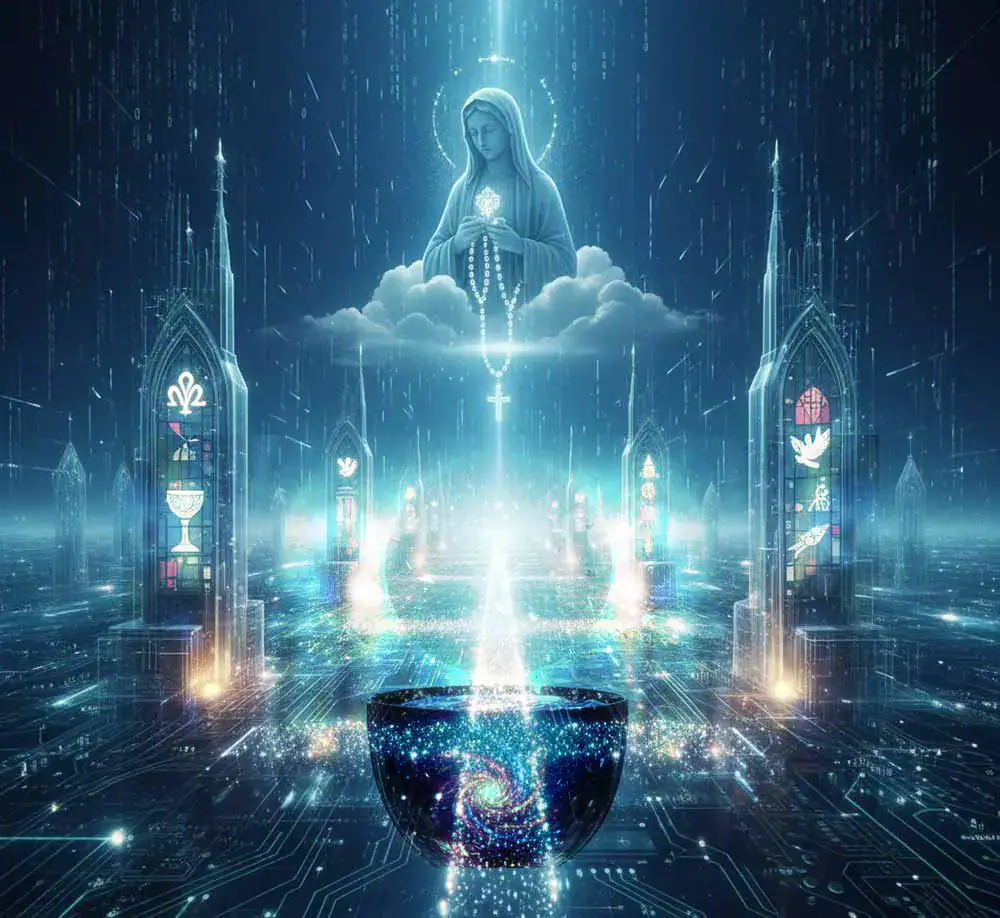
As the world becomes increasingly digital, the way people experience and interact with their faith is changing. Livestreamed Masses and virtual worship have become more common, especially for those who are homebound or geographically isolated. However, Dr. Dimakatso Michelle Polokelo warns that this shift towards virtual worship may have unintended consequences, particularly when it comes to the Eucharist. The convenience and accessibility of virtual worship may lead people to prefer it over traditional, in-person worship.
The concept of hyperreality, coined by French philosopher Jean Baudrillard in 1981, describes a condition in which representations replace reality. In the context of virtual worship, this means that the digital Eucharist becomes an image of holiness without the material mediation of grace. The "presence" perceived through a screen or headset is not the Real Presence of Christ but its representation. This raises fundamental theological concerns about the nature of sacramental participation and the role of technology in worship.
The Catholic Church has always adapted to new means of communication, but the digital age presents a unique challenge. The Eucharist, a sacrament that depends on embodied encounter, material elements, and gathered community, is at risk of being reduced to a simulation. While technology can extend pastoral reach and provide greater accessibility, it is essential to discern how to inhabit digital spaces without surrendering to their logic. Pope Francis has encouraged the use of digital technology, but also warned about the dangers of virtual proximity.
The Church's digital migration has involved genuine pastoral creativity, with livestreamed liturgies, online catechesis, and 3D renderings of sacred spaces. However, advocates of virtual worship must be cautious not to mistake digital mediation for sacramental participation. In a virtual Mass, the worshipper's attention may be engaged, but their physical presence, a necessary condition for sacramental participation, remains absent. The sacred sign detaches from the sacrament itself, and the digital Eucharist becomes an image of holiness without the material mediation of grace.
The Real Presence of Christ cannot be transmitted through bandwidth, and the Eucharist cannot be reduced to information. Its essence is incarnational, requiring bread to be broken, wine poured, and a body gathered. When a priest consecrates the host on a livestream, the consecration is real, but the mediation through a screen does not make the viewer a sacramental participant. Online Masses may nourish devotion, but they do not constitute sacramental acts for those watching.
The deeper problem emerges when believers begin to prefer the simulation to the sacrament. The heart of Christianity is not abstraction but Incarnation, and the mystery of salvation unfolds not through code but through contact. Jesus touches the blind, eats with sinners, and breaks bread with his disciples. God reveals himself not as data but as flesh. Digital culture subtly reverses this logic, replacing bodies with profiles, communities with networks, and relationships with algorithms.
The Church must become a countercultural witness, embracing digital technology while remaining true to its incarnational logic. Pope Benedict XVI warned that when liturgy becomes show, we no longer see the divine but only ourselves. Virtual worship could unintentionally fulfil that warning, transforming worship into a mirror of human design rather than divine encounter. The challenge is discernment: how to inhabit digital spaces without surrendering to their logic.
Key points
- The rise of virtual worship raises concerns about the nature of presence and sacramental participation in the digital age.
- The concept of hyperreality describes a condition in which representations replace reality, with implications for virtual worship.
- The Church must discern how to inhabit digital spaces without surrendering to their logic, remaining true to its incarnational logic.