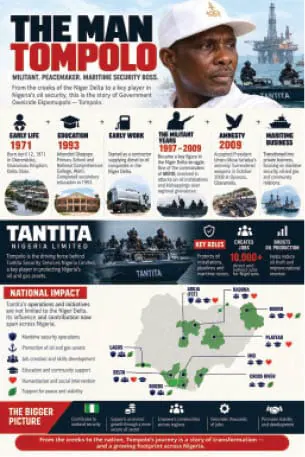
Government Oweizide Ekpemupolo, known as Tompolo, has been a significant figure in Nigeria's Niger Delta region for over two decades. Born on April 12, 1971, in Okerenkoko, Gbaramatu Kingdom, Delta State, Tompolo rose to prominence during the armed struggle in the oil-rich Niger Delta. As an Ijaw by tribe, he hails from Gbaramatu Kingdom in Delta State. His early life in the riverine environment shaped his militant activities and business career. Tompolo attended Okepopo Primary School in Warri and the National Comprehensive College, Warri, completing his secondary education in 1993.
Tompolo's entry into activism was influenced by the political and communal tensions in Warri and its surrounding areas in the late 1990s. The relocation of a local government area's headquarters from Ogbe-Ijoh to Ogidigben intensified tensions between Ijaw and Itsekiri communities, leading him to associate with the Federated Niger Delta Ijaw Communities. Between 1997 and 2002, Tompolo became involved with the Ijaw Youth Council and the armed Niger Delta struggle, emerging as one of the commanders of the Movement for the Emancipation of the Niger Delta (MEND). MEND targeted oil installations and personnel, seeking to pressure the federal government and oil companies over Niger Delta grievances.
Tompolo's activities disrupted oil production, contributing to insecurity in the oil-producing region and affecting the country's economy. His name became associated with Delta State's creeks, where the terrain gave militant groups an operational advantage. As a prominent militant commander, Tompolo's campaign involved attacks on oil infrastructure, kidnappings, and disruptions to petroleum production. The conflict was driven by grievances over the perceived neglect of oil-producing communities and demands for greater participation in the region's resources.
In 2009, President Umaru Musa Yar'adua introduced an amnesty programme for militants in the Niger Delta, which Tompolo accepted. In October 2009, he surrendered weapons at Oporoza in the Gbaramatu area, marking a turning point in his life. The disarmament ceremony included the handover of rocket launchers, machine guns, and explosives. After the surrender, Tompolo remained influential in the Niger Delta, transitioning into private business, particularly in maritime security, oil and gas, and community relations.
Tompolo's familiarity with the Niger Delta waterways became an asset in an environment where oil companies and government agencies faced security and logistics challenges. One of his notable ventures was Global West Vessel Specialists Limited, which became linked to a public-private arrangement with the Nigerian Maritime Administration and Safety Agency (NIMASA) in 2011-2012. The arrangement involved providing platforms, equipment, and expertise to secure Nigeria's waterways and improve revenue collection.
Global West was later subsumed into Tantita Security Services Nigeria Limited (TSSNL), which gained national prominence in 2022 when the Nigerian National Petroleum Company Limited (NNPCL) awarded it a pipeline surveillance project valued at N48 billion. The contract involved protecting oil pipelines and production facilities in the Niger Delta region. In 2023, the NNPCL renewed the contract for three years, expanding Tantita's operations to cover protection and surveillance of oil pipelines in several states.
The NNPCL deal has faced criticism, but former CEO Malam Mele Kyari defended the contract, citing the need for secure oil production. Tompolo's transition from militancy to business and politics has been marked by his involvement in various activities, including the Egbesu spiritual tradition. He is often sighted during worship sessions and has been described as the chief priest of the Egbesu Shrine in Oporoza. Tompolo is married to Victoria Ekpemupolo and has children, including a publicly known daughter.
Key points
- Tompolo's transition from militancy to business and politics has been shaped by his involvement in various activities, including maritime security and community relations.
- The NNPCL deal has faced criticism, but former CEO Malam Mele Kyari defended the contract, citing the need for secure oil production.
- Tompolo's influence in the Niger Delta region extends beyond business to spiritual activities, including the Egbesu spiritual tradition.