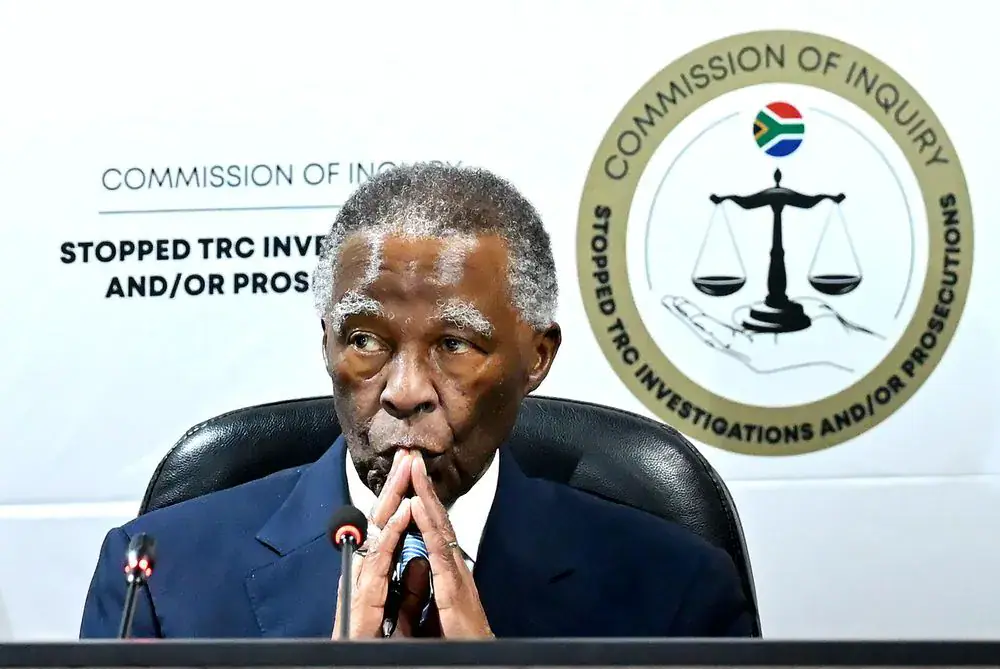
The recent proceedings surrounding the Khampepe Commission have reignited a narrative in South Africa that brands Nelson Mandela, Thabo Mbeki, and their peers as "sell-outs" who surrendered the revolution at Codesa. However, writer Phapano Phasha argues that this view judges history through narrow, legalistic moralism, ignoring the cold material realities of 1994. Phasha, chairperson of The Centre for Alternative Political and Economic Thought, contends that the negotiated settlement and conditional amnesty were strategic necessities dictated by a rigid matrix of objective and subjective constraints.
Phasha points out that long before the ANC sat at Kempton Park, its primary international patrons, China and the Soviet Union, had already pivoted to global capital. Following Mao's death, Deng Xiaoping initiated Gaige Kaifang to save China from economic collapse, while Mikhail Gorbachev introduced Perestroika, signaling the USSR's economic insolvency and retreat from proxy wars. This shift in global politics had significant implications for the ANC's struggle against apartheid.
In international relations, nations are governed by Realpolitik. If the superpowers funding and arming the liberation movement had to concede to global capital for their own survival, by what logic was an ANC that had not won a conventional war expected to wage an isolated, economically suicidal confrontation? Phasha argues that ignoring the global balance of power is not bravery, but strategic incompetence.
Domestically, the balance of power was equally unyielding. The ANC did not win a conventional military war; there was no heroic march into Pretoria. In 1994, the apartheid security apparatus remained fully armed, and a right-wing coup was a severe threat. Demanding the immediate arrest of the old regime would not have delivered justice; it would have triggered a scorched-earth civil war.
The Truth and Reconciliation Commission and its conditional amnesty were the agonizing but necessary prices for a peaceful transfer of power. Mandela and Mbeki swallowed immense personal tragedy, including Mbeki's loss of his son and brother to apartheid death squads, to secure this transition. Consequently, unlike Angola or Mozambique, South Africa inherited a functioning state with intact infrastructure and advanced institutions.
Phasha argues that the claim that leaders "should not have settled for mere political power" relies on a childish fantasy: that a liberation movement could overthrow the regime, confiscate the economy overnight, and somehow inherit a prosperous society. Instead, the 1994 settlement delivered a constitutional democracy and a resilient legal framework. Political power is never the final destination; it is the supreme leverage point.
The central tragedy of post-apartheid South Africa is that the post-Mandela generation received this working machine and converted it into a consumer crusade. We are now approaching a fiscal cliff, burdened by climbing debt and a dangerously narrow tax base. Instead of exercising fiscal discipline and boosting local manufacturing, our public culture is dominated by entitlement. Current ANC leaders have reduced political power to tenderpreneurship, detached governance, and luxury consumption.
Key points
- The 1994 settlement was a strategic necessity that handed South Africa a functioning democracy.
- The ANC's primary international patrons had already pivoted to global capital before the 1994 settlement.
- The post-Mandela generation has failed to manage the economy effectively, leading to a fiscal crisis.